

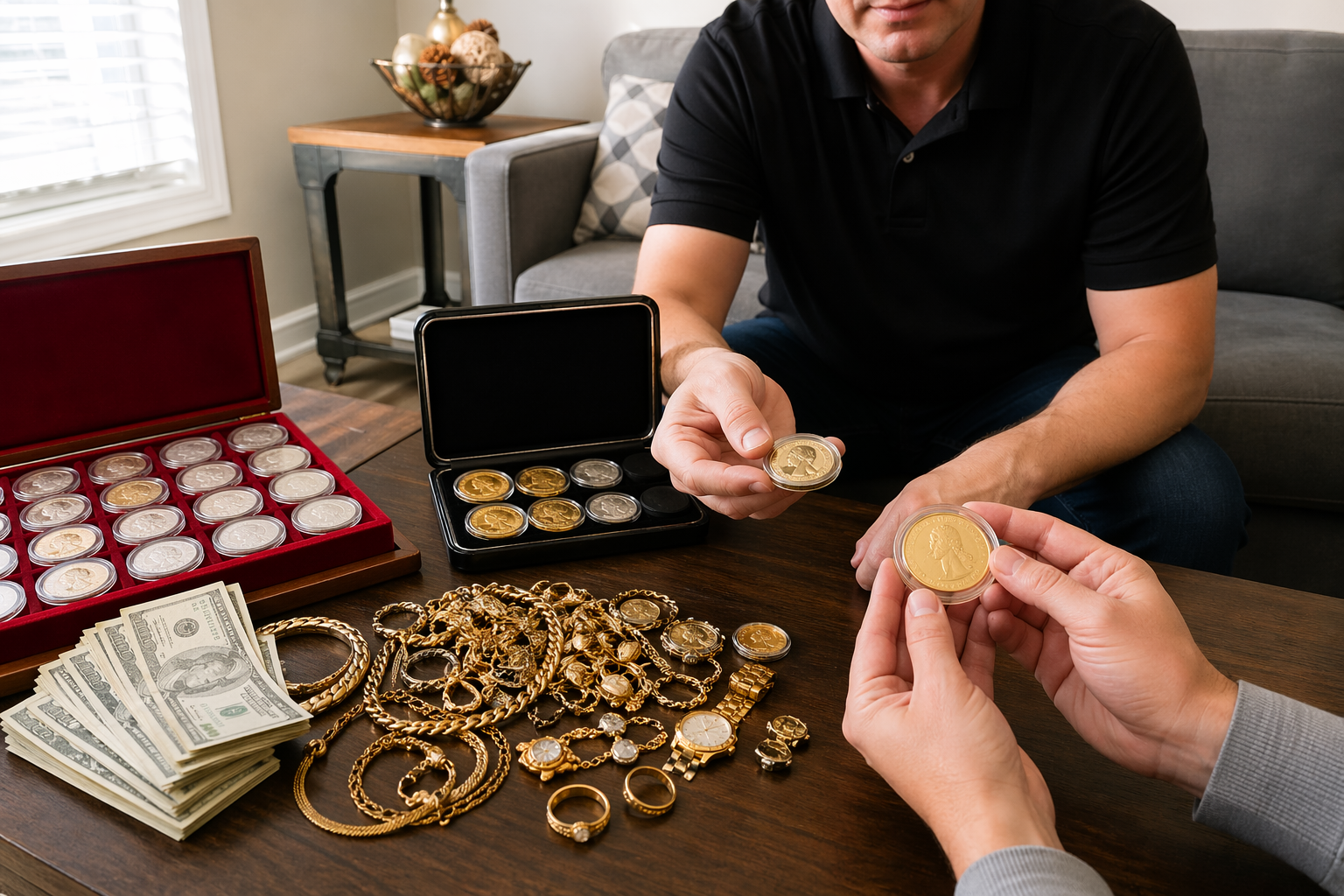
You've got a collection of coins, some gold jewelry, a box of vintage items, or maybe an entire estate's worth of belongings — and you want to sell. The first thing most people do in that situation is open up their phone and think: Craigslist. Facebook Marketplace. eBay.
It makes sense. Those platforms are familiar, free to list on, and give you a sense of control. You set your price. You decide who to sell to. You handle it yourself.
But here's what most people discover only after they've already spent three weeks dealing with flaky buyers, lowball offers, scam attempts, and strangers at their door: DIY selling isn't as simple, safe, or profitable as it looks. Especially when you're selling coins, jewelry, antiques, and collectibles — items where value is nuanced, buyers can be predatory, and the stakes of getting it wrong are real.
This post is a direct comparison. Let's look at each platform honestly — what it's good for, what it costs you, and why, for most Maryland sellers of valuable items, a single appointment with a trusted mobile buyer is a simpler, safer, and often more profitable path.
The Hidden Costs of "Free" Platforms
Before we get into the specific risks of each platform, let's address the biggest misconception: the idea that listing on Craigslist or Facebook Marketplace is free.
It's free to post. It is not free to sell.
The real costs come in forms that don't appear as line items: the time you spend writing descriptions and taking photos, the hours responding to inquiries that go nowhere, the emotional energy of managing negotiation after negotiation, the risk of being underpaid because you don't know exactly what you have, and — for some sellers — the very real cost of being scammed or robbed.
When you account for all of that, "free" platforms aren't always free at all.
Craigslist: The Original Wild West
Craigslist has been connecting local buyers and sellers for nearly 30 years, and it remains one of the most widely used classifieds platforms in Maryland. For selling a couch or a used lawnmower, it works fine. For selling coins, gold jewelry, or anything else of serious value, it's a different story entirely.
The Safety Problem Is Real
Craigslist's own safety guidelines tell you quite a bit about the platform's risks. Craigslist advises its users: do not meet in a secluded place or invite strangers into your home, and be especially careful buying and selling high-value items. craigslist
That warning is there for a reason. The FBI has documented organized robbery crews that specifically targeted Craigslist sellers of jewelry, watches, and coins. One Bay Area robbery crew is estimated to have stolen more than $500,000 in jewelry from Craigslist victims who traveled from more than six states between November 2012 and December 2013 — including a $90,000 Cartier watch, a $14,000 Rolex watch, and a $19,000 engagement ring. FBI These weren't random crimes. They were systematic operations that specifically hunted for Craigslist listings of high-value items.
If you meet a buyer at a public location, you've broadcast to a stranger that you're carrying something valuable. If you invite them to your home, the risk is even greater. If buyers go into your home, they can scope out the valuables inside. They might grab something and run — or see things they want to come back and steal later. NBC News
None of this means every Craigslist transaction ends in disaster. The vast majority don't. But when you're selling something with real monetary value — a coin collection, a gold jewelry set, a box of silver dollars — the risk profile changes meaningfully, and it's worth asking whether the platform was really designed for that kind of transaction.
The Lowball Problem
Even setting safety aside, Craigslist buyers are almost universally bargain hunters. The platform attracts people specifically looking to buy below market value — people who know they can make lowball offers on sellers who don't know exactly what they have, and who are willing to wait out uncomfortable negotiations until someone accepts less than they deserve.
If you're selling a collection of pre-1965 silver coins and you post them for a rough melt estimate, you're likely to be contacted first by experienced dealers and resellers who know precisely what your coins are worth — and whose job it is to pay you as little as possible for them.
The Friction Problem
Even when everything goes right, Craigslist transactions are work. Writing the listing, uploading photos, responding to messages, screening inquiries, coordinating meeting times, dealing with no-shows, renegotiating at the last minute when the buyer decides they want to pay less in person — all of that is unpaid labor on top of the actual sale.
For a collection of items — not just one thing, but coins and jewelry and collectibles together — the idea of listing each piece separately on Craigslist and managing individual transactions is genuinely exhausting.
Facebook Marketplace: More Convenient, Same Core Problems
Facebook Marketplace has largely replaced Craigslist for local sales among younger sellers, and in some ways it's an improvement — profiles are linked to real identities, there's a ratings system, and the interface is cleaner. But many of the fundamental problems remain, and some new ones get added.
The Scam Ecosystem
Scammers on Facebook Marketplace use a variety of schemes targeting sellers. Meta has invested $8 billion in security since 2019, yet scammers will try almost anything to get you out of that ecosystem — because once you communicate outside of Messenger, Facebook's protections largely disappear. Norton LifeLock
Some of the most common scams targeting sellers of valuable items include:
The overpayment scam. A buyer pays more than the requested amount — say $350 for a $300 item — then claims to have made a mistake and requests a partial refund. After you send the refund, the original payment is declined and never ends up in your account, while the scammer pockets what you sent. Reader's Digest
The verification code scam. A scammer sends a verification code to your phone and claims they need it to confirm your identity before completing a sale. If you share the code, they can use it to access your accounts or create a fake account in your name. Norton LifeLock
The profile trick. If a buyer's profile was created within the last few days, they are most likely a scammer. Legitimate buyers on Facebook Marketplace typically have established profiles that show they are real people with genuine posts and friends. Keeper Security
The home scouting problem. Personal safety experts have noted that questions about your home layout, living situation, or whether you have help moving items aren't always innocent. Criminals want to understand your habits and the layout of your home so they can return and break in later. Reader's Digest
The Negotiation Grind
Facebook Marketplace has a culture of aggressive negotiation baked in. The "Is this still available?" opener is almost universally followed by an immediate offer well below your asking price. For casual sellers moving furniture or clothes, this is manageable. For someone selling items with real monetary value who may not have deep knowledge of what they're worth, it's an environment that consistently rewards the buyer at the seller's expense.
The Time Cost
Like Craigslist, Facebook Marketplace requires you to do all the work: photography, descriptions, inbox management, scheduling, screening, rescheduling when buyers ghost, and then starting over. For a single item, that's a reasonable tradeoff. For an estate's worth of coins, jewelry, and collectibles, it's a part-time job.
eBay: The Most Reach, the Highest Costs
eBay is genuinely the best platform of the three for reaching a national audience of collectors willing to pay retail prices for the right item. For someone with the time, knowledge, and patience to navigate the platform well, it can produce strong returns on rare or high-demand pieces.
But it comes with a cost structure and complexity that most casual sellers significantly underestimate.
The Fee Reality
eBay's fees are not trivial. One seller who sold a one-ounce gold coin for $1,775 found that eBay took out 12.9% on the sale — over $220 — leaving a final amount of $1,550, or $200 below what the coin could have fetched locally with no fees at all. EBay
Final Value Fees on jewelry are 15% if the total amount of the sale is $5,000 or less. On top of that, promoted listing fees, insertion fees, and international fees can push total costs to 20% or more. EBay
That means for every $1,000 you sell on eBay, you could realistically walk away with $800 or less — before accounting for your time, shipping materials, and insurance.
The Shipping Risk
Sending valuable items through the mail introduces a category of risk that doesn't exist in a local transaction. eBay fees may take up to 12% of charges, and you are also worried about the shipping process as the item can get lost during shipping. California Gold and Silver Exchange Insuring a package of silver coins or a gold jewelry set for its full value adds cost. And if something goes wrong — the package is lost, damaged, or the buyer claims it was — you're in eBay's dispute resolution process, which historically skews toward buyers.
The Jewelry and Coins Fraud Problem
The jewelry and coin categories on eBay attract a disproportionate share of fraudulent activity precisely because the items are valuable, portable, and easily misrepresented. There are too many ways for buyers to cheat sellers and complain about what they received. A scammer buyer can claim they received a cheap sterling silver ring instead of a diamond ring and return that, keeping the valuable item for themselves. EBay eBay's buyer protection policies make it very difficult for sellers to prevail in these disputes.
The Knowledge Requirement
To sell coins profitably on eBay, you need to be able to properly evaluate the value of what you're selling. You need to know the different types of defects, the correct terminology to describe them, and how those things affect value. Quora Sellers who don't have that knowledge tend to underprice, misdescribe, or attract buyers who exploit the knowledge gap.
The Time Investment
Selling on eBay requires you to manage photography, listings, shipping, and customer service. Listing and final value fees of around 10–13% eat into profits, plus there are risks of scams, returns, or non-payment. Beantowncoins From listing to payment, a single item can take weeks. A full collection could take months.
What a Mobile Buyer Actually Looks Like in Practice
Here's what the alternative looks like with Sanford & Son:
You call or text (410) 746-5090. We schedule a time to visit your home anywhere in Maryland — evenings and weekends included, seven days a week. Our expert arrives, reviews your coins, jewelry, collectibles, antiques, and whatever else you'd like us to look at. We explain what we're seeing in plain language, tell you what things are worth, and make you a fair cash offer on the spot. You decide whether to accept. If you do, we pay you immediately. No strangers at your door later. No packages to ship. No fees taken out. No disputes. No waiting.
The entire process — for a collection that might take weeks to sell piece by piece online — is completed in a single appointment.
Here's How the Economics Compare
Let's say you have a collection of pre-1965 silver coins, some gold jewelry, and a few vintage collectibles with a combined fair market value of $2,000.
eBay route: After 15% final value fees on jewelry and 12.9% on coins, shipping and insurance costs, and the time investment of photographing and listing everything, you might net $1,600–$1,700 — if everything sells, nothing gets disputed, and nothing gets lost in transit. Timeline: 4–8 weeks.
Facebook Marketplace/Craigslist route: You'll be negotiating against experienced resellers who are trying to buy low. You might net $1,200–$1,500 if you hold firm and don't get scammed. Timeline: 1–3 weeks of active management.
Sanford & Son: One appointment. Fair market offer based on current precious metal prices and numismatic value. Cash in hand the same day. No fees. No strangers. No risk. Timeline: one visit.
The difference isn't always enormous on every item. But it's consistent, and it compounds across a full collection.
The Credentials Behind the Offer
Not all buyers who come to your home are the same. The difference between a licensed, credentialed buyer and a random person responding to your Craigslist ad is significant.
Sanford & Son is licensed, bonded, and insured. We're a member of the Numismatic Guaranty Company (NGC) — the same professional organization that authenticates and grades coins for major auction houses. That membership isn't just a credential on a website. It means our buyers are held to professional standards of knowledge and fair dealing, and it means the appraisals we give you are grounded in the same framework that professional numismatists use.
When we tell you a coin is worth $200, it's because we know coin markets, we know current silver and gold prices, and we have the expertise to distinguish a common date from a key date, a cleaned coin from one in original condition, and a genuine error from post-mint damage. You're not guessing, and neither are we.
When DIY Platforms Make Sense
To be fair: there are situations where eBay or other platforms are genuinely the right call.
If you have a single, well-identified rare coin with strong auction comparables and you're willing to put in the work to list it, photograph it professionally, and navigate the shipping and insurance process, eBay can help you reach the widest possible audience of collectors — which is where the highest prices for truly exceptional pieces tend to come from.
If you're selling items that aren't coins, jewelry, or collectibles — furniture, appliances, everyday household goods — Facebook Marketplace and Craigslist are perfectly reasonable options where the risks are much lower and the DIY effort is proportionate.
But for coins, precious metals, jewelry, antiques, and collectibles — where value is nuanced, fraud risk is elevated, and the gap between what an informed buyer pays and what an uninformed seller accepts can be substantial — the in-home buyer model removes nearly every friction point from the equation.
The Bottom Line
Craigslist, Facebook Marketplace, and eBay are tools. Like any tool, they work well for some jobs and poorly for others. Selling valuable coins, jewelry, and collectibles to strangers you've never vetted, at prices you've arrived at through guesswork, while managing scam attempts and no-shows from your living room — that is not what those tools were built for.
A single appointment with Sanford & Son replaces all of it. One call. One visit. One fair offer. Cash in hand.
Ready to Skip the Hassle?
If you have coins, jewelry, collectibles, or estate items to sell anywhere in Maryland, we'd love to come take a look.
📞 Call or text: (410) 746-5090 Open 7 days a week, 7am–7pm
🌐 Contact us online: sanfordandsoncoins.com/contact-us.html
No listings to write. No strangers to vet. No fees to pay. Just a fair offer from a licensed, bonded buyer — at your door, on your schedule.
Frequently Asked Questions
Is selling to a mobile buyer really safer than meeting someone from Facebook Marketplace?
Yes, in a meaningful and documented way. When a stranger responds to your listing online, you have no verified information about who they are, what their intentions are, or whether their interest in your items is legitimate. When Sanford & Son comes to your home, you're dealing with a licensed, bonded, and insured company with a verifiable track record in Maryland. We're not an anonymous profile. We're a real business with real accountability — and we're coming to evaluate your items, not to case your home.
Won't I get more money selling online where I can reach more buyers?
Sometimes, for specific rare items where a large collector audience drives up the price. But for the vast majority of coins, jewelry, and collectibles, the realistic net after eBay fees (12–15%), shipping and insurance, and the time cost of managing listings is often comparable to or less than what a fair local buyer will pay — without any of the headaches. The exception is a genuinely rare, museum-quality piece where auction exposure truly matters. For everything else, local is usually smarter.
How do I know I'm getting a fair price from a mobile buyer?
Ask questions. A trustworthy buyer should be able to explain exactly how they arrived at their offer — current silver or gold spot price, the grade and condition of a coin, the karat weight of jewelry. At Sanford & Son, we walk you through our reasoning. We're NGC members, which means we operate under professional numismatic standards. If you want to compare our offer to a reference price before accepting, we encourage it.
What if I only have a few items — is it worth calling?
Absolutely. We don't have minimum transaction requirements. Whether you have a single coin that looks interesting or a full estate to evaluate, we'll come take a look. The appointment is free and there's no obligation to sell.
What about pawn shops — aren't they a better local option than online platforms?
Pawn shops serve a different purpose: they're primarily in the business of making short-term collateralized loans, which means they need to buy items at a significant discount to their value in order to profit on the loan spread. Their offers on coins, jewelry, and collectibles are typically well below fair market value. A dedicated mobile buyer like Sanford & Son is in the business of buying — not lending — which allows us to pay closer to actual market value.
Can I sell just part of a collection, or does it have to be everything?
You can sell whatever you'd like. There's no requirement to sell everything we look at. Some people want us to evaluate a full estate and make an offer on everything. Others want a second opinion on a few specific pieces. We're flexible — the appointment is for your benefit, not ours.
What payment methods does Sanford & Son use?
We pay cash on the spot for items we purchase. There are no checks to wait on, no PayPal transfers to track, and no payment disputes to navigate. If we make an offer and you accept, you're paid immediately before we leave.
