

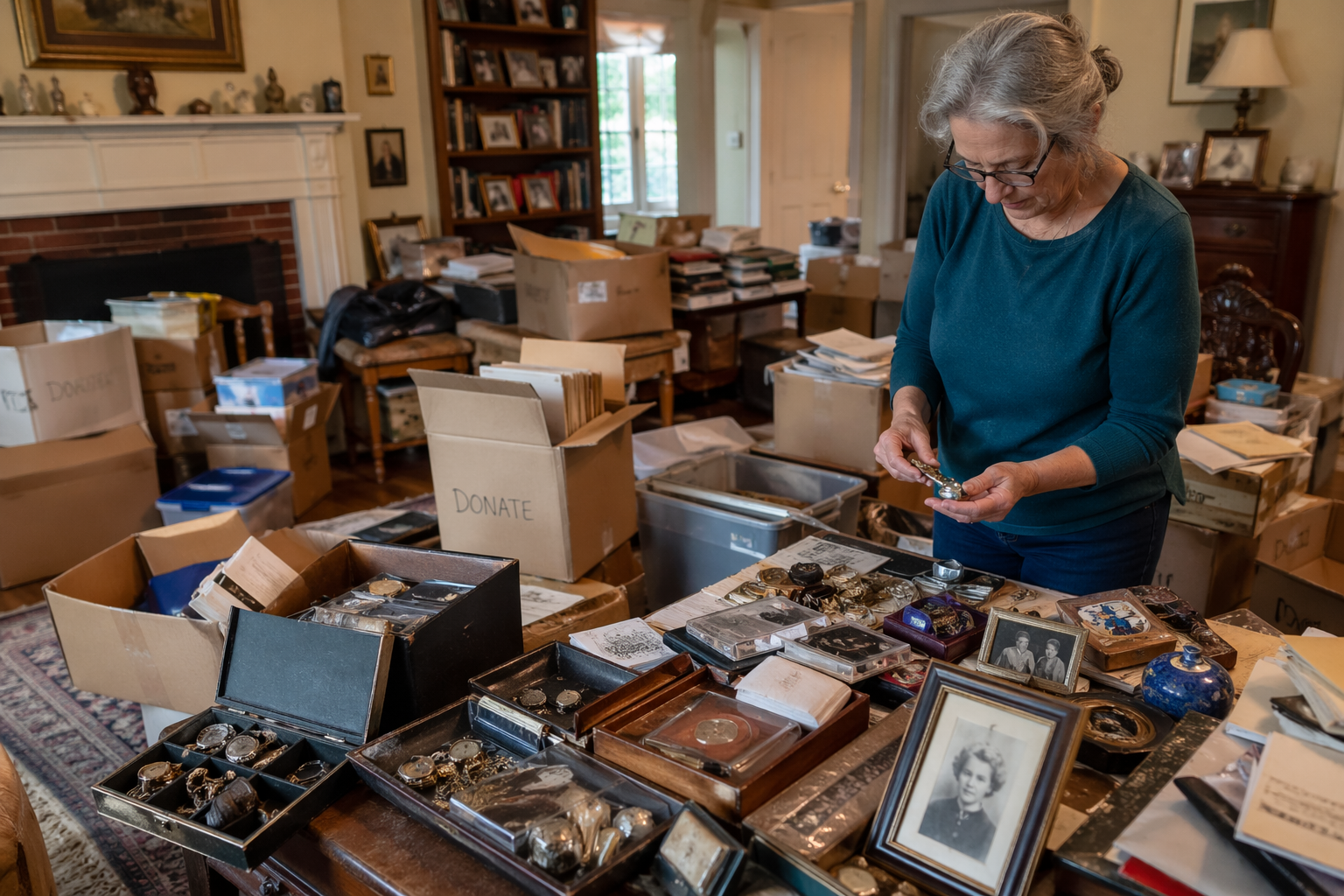
Nobody prepares you for this moment.
You walk into a house that belonged to someone you loved — a parent, a grandparent, an aunt or uncle — and you're confronted with a lifetime of accumulated belongings. Furniture in every room. Closets packed to the ceiling. Boxes in the basement that haven't been opened in twenty years. Kitchen cabinets full of things that were put there sometime in the 1980s and never moved.
And somewhere in all of that, almost certainly, are things of real value — coins, jewelry, silverware, collectibles, gold — that most families either overlook completely or sell for a fraction of what they're worth because they didn't know what they had.
This guide is for Maryland families navigating exactly this situation. It covers the practical steps — legal, logistical, and emotional — in roughly the order you'll need them, with specific guidance for every category of item you're likely to encounter. By the time you finish reading, you'll have a clear picture of how to move through an inherited house systematically, what to keep, what to donate, what has real monetary value, and how to make sure you don't accidentally leave money on the table.
Before You Touch Anything: The Legal Foundation
Understand Your Role and Authority
Before sorting a single drawer, you need to know whether you have the legal authority to make decisions about the property and its contents. In Maryland, this depends on your relationship to the estate and whether probate has been opened.
In Maryland, almost all wills go through the probate process to validate their legality and ensure the personal representative can administer the estate. The personal representative is appointed to manage the probate estate and act on behalf of the estate. Yes I Pay Cash
If you are the named personal representative (also called the executor) in the will, you have legal authority to manage, inventory, and eventually distribute or sell the estate's assets — but only after the probate court formally appoints you. If you're not the personal representative, your authority to make decisions about the contents of the home is limited until the estate is properly opened.
Within three months of appointment, the personal representative must file a complete inventory of all of the decedent's assets, including their date-of-death value, that they solely owned. Maryland People's Law Library This is important context: disposing of, donating, or selling estate assets before the estate is properly administered can create legal complications.
What this means practically: Contact the Register of Wills in the Maryland county where the deceased lived. Maryland has a Register of Wills in every county and Baltimore City, and they provide guidance on how to open an estate and what's required. You can find your local Register of Wills at registers.maryland.gov.
Secure the Property First
The first step upon inheriting a house is to assess the estate and determine your role in the process. Before doing anything else, check if the property is part of a will or trust to understand your rights and responsibilities. Knowing the full picture helps you decide your next steps. Yes I Pay Cash
Change the locks promptly. You don't know who may have had a key — neighbors, home health aides, contractors, friends. Secure the home before anything valuable is at risk.
Maintain the utilities and homeowner's insurance. A vacant property that loses heat in winter or has an undetected water leak can suffer serious damage quickly. Keep the insurance policy active until the estate is settled and the property transferred or sold.
Forward the mail and collect any important documents — bank statements, insurance policies, tax notices, mortgage statements — before they pile up or get misplaced.
Gather All Important Documents First
Before sorting a single physical item, do a sweep of every room looking for documents. In addition to personal belongings and furniture, you'll probably discover many documents all around the house. Some paperwork, like junk mail and shopping lists, can be tossed out. But it's essential to sort through all mail and papers you find to avoid throwing out anything important. Cake
Look specifically for: the original will and any codicils, deeds and property records, vehicle titles, bank and investment account statements, life insurance policies, tax returns from recent years, birth and marriage certificates, military discharge papers (DD-214), and Social Security cards. These documents will all be needed during estate administration and should be collected into one secure location before any clearing out begins.
Taking Inventory: A Room-by-Room Approach
Once the legal foundation is in place and the property is secured, the actual work begins. The most effective approach is room by room, starting with the areas most likely to contain documents and valuables.
The System That Works
Experts say it hastens the process if you sort belongings into three piles or tag them with color-coded stickers of three different colors: items to keep, items to donate or sell, and items to throw away. Pro Junk Dispatch
We'd suggest a four-category approach:
Keep — Items family members want to retain for sentimental or practical reasons. Be selective. Not everything with a memory attached needs a physical home.
Sell — Items with monetary value that deserve more than a donation bin. This is the category most families handle worst, and we'll cover it in detail.
Donate — Items in good, usable condition that no one in the family wants but that could benefit someone else.
Discard — Broken items, expired goods, unusable materials. A dumpster rental or junk removal service handles this category efficiently.
Start at the Top
It is always better to start at the top of the house and work your way down. CNBC Attics and upper floors tend to hold the oldest and most historically interesting items — and often the most financially valuable ones. Coin collections, stored silverware sets, old military memorabilia, boxes of jewelry, and documents tend to migrate upward in a home over decades and get forgotten.
Don't rush the attic. Move through it carefully and set aside anything you don't recognize or understand before making any decisions about it.
The Rooms That Require Extra Care
Master bedroom and dressers: This is typically where jewelry, watches, and coins are concentrated. Check every drawer thoroughly, including the backs and underneath items. Check the inside of sock drawers, under the bed, in the back of closets, in shoe boxes, in velvet pouches, and in small boxes. Older generations often kept cash and valuables distributed throughout the bedroom rather than in a single secure location.
Home office or desk area: Important documents, financial records, and sometimes valuable stamps, coins, or collectibles. Don't discard any paper until you've at least glanced at it. Shred sensitive documents rather than putting them in recycling.
Dining room and china cabinet: Sterling silverware, decorative silver pieces, fine china, and crystal. Check the backs of silver pieces for "Sterling" or "925" stamps. Silver-plated items (marked "EPNS," "EP," or "Silver Plate") have minimal melt value but may still be collectible.
Basement and garage: Tools, collections, sports equipment, and stored items. Old coin albums and collections are frequently found in basements. Military memorabilia — uniforms, medals, helmets, documents — is commonly stored in basement storage or in trunks. Don't discard boxes of "miscellaneous" items without opening and looking through them.
Throughout the house: Any jar, can, or container of change deserves a look. Pre-1965 U.S. coins mixed into general change are worth many times face value at current silver prices. A coffee can of old coins could be worth several hundred dollars.
The "Sell" Category: Where Families Leave the Most Money Behind
This is the section most estate guides don't cover adequately, because the writers don't have expertise in what valuable items look like and what they're actually worth.
The truth is that in nearly every Maryland estate, there are items with real monetary value that get donated, discarded, or given away before anyone realizes what they were. The most common culprits:
Coins
Any coins in labeled albums, folders, velvet-lined boxes, or plastic holders deserve professional evaluation before anything else. Beyond formal collections, look for jars, tins, and bags of loose change — especially anything containing coins that look older or different from modern pocket change.
The simple rule: U.S. dimes, quarters, and half dollars dated 1964 or earlier are 90% silver. At current silver prices around $75+ per ounce, a pre-1965 quarter contains about $14 in silver alone — roughly 56 times face value. Morgan and Peace silver dollars (large coins from 1878–1935) are worth $50+ each even in worn condition.
Don't spend, donate, or discard any coins before having them looked at.
Gold and Silver Jewelry
Check every piece of jewelry — including broken chains, single earrings, and pieces that look like costume jewelry — for karat stamps. Look inside rings, on clasps, on the backs of earring posts. Stamps reading "10K," "14K," "18K," "585," "750," or "925" indicate genuine precious metal. With gold currently trading near $4,700 per ounce, even small amounts of genuine gold jewelry represent meaningful cash value.
A broken 14K gold chain is worth exactly the same as an intact one of the same weight. Don't discard anything that might be gold without testing it.
Sterling Silverware and Serving Pieces
Look on the back of every piece of flatware and every serving piece for "Sterling" or "925" stamps. A complete sterling flatware set for 12 can be worth $800–$1,500 at current silver prices. Individual serving pieces add up. A sterling silver tea set or tray can be worth hundreds of dollars in silver content alone.
The distinction that matters: "Sterling" means genuine silver. "EPNS," "EP," "Silver Plate," or no marking typically means silver-plated base metal, which has minimal value.
Watches and Pocket Watches
Open the back case of any pocket watch and look for the maker's name on the movement. American makers like Elgin, Waltham, and Hamilton produced watches worth $200–$2,000+ in working condition. European makers (Patek Philippe, Vacheron Constantin) command far more. The case material also matters: a solid gold case carries intrinsic melt value in addition to any collector premium.
Military Items
Service medals with original ribbons, presentation boxes, and documentation; named dog tags; military uniforms with insignia intact; WWII-era captured items; military photographs with identifying information — all of these have active collector markets and can be worth significantly more than they appear. Documentation and provenance are especially important: a named medal with its original certificate is worth dramatically more than an unnamed one.
Sports Cards and Memorabilia
Pre-1980 baseball cards of Hall of Famers and star players, cards in better condition, tobacco-era cards from the early 1900s, and autographed items are all potentially valuable. The key rule: pull out anything featuring legendary players from before 1980 and have it evaluated before donating or discarding.
The Rule That Matters Most
Don't make permanent decisions about anything you don't fully understand. Set unknowns aside in a designated "evaluate" area. Call in an expert before those items leave the house. The cost of having something looked at is zero. The cost of donating a $500 coin collection is $500.
The "Donate" Category: Doing Good With What Remains
Once the valuable items have been identified and set aside, donation is the best path for useful items that nobody in the family wants. Maryland has a strong network of organizations that accept household items, and several offer free pickup — essential when you're dealing with a full house.
Habitat for Humanity ReStore — Accepts furniture, building materials, appliances, tools, and home decor. Multiple locations throughout Maryland, with pickup available for larger items. Contact Habitat for Humanity Metro Maryland at 301-926-4104 or visit habitatmm.org.
Vietnam Veterans of America via Pickup Please — Accepts clothing, small appliances, household items, toys, and electronics. Offers free scheduled pickup throughout Maryland. Visit pickupplease.org or call 1-800-775-8387.
AMVETS — Accepts clothing, electronics, small appliances, and household items throughout Maryland, Washington D.C., and Northern Virginia. Schedule pickup at amvetspickup.org.
Charlotte's Web Enrichment Center — Accepts furniture and household items throughout Maryland, directing items to families in need including domestic violence survivors. Contact at charlotteswebec.org.
Goodwill, Salvation Army, and local thrift stores — Accept a wide range of household items. Some locations offer pickup for larger donations.
A few donation ground rules worth knowing: donation organizations want usable items in good condition. A couch with broken springs or a mattress with stains will be turned away and becomes your problem to dispose of. When in doubt about whether something qualifies, call ahead. And keep donation receipts — they're tax-deductible if the estate itemizes.
The "Discard" Category: Dealing With What Nobody Wants
Not everything in an estate can be donated or sold. Broken furniture, old medications, expired food, outdated electronics, damaged items, and genuine junk need to go.
For large-scale disposal, a dumpster rental is the most efficient solution. Container sizes typically range from 10 to 40 cubic yards, and pricing in Maryland generally runs $350–$700 per week depending on size and location. Search "dumpster rental Maryland" to find local providers.
For hazardous materials — old paint, chemicals, pesticides, motor oil — Maryland has household hazardous waste drop-off programs. Contact your county's waste management office for specific locations and schedules, as these vary by county.
Electronics require responsible recycling. Most Maryland counties have e-waste drop-off programs, and Best Buy accepts electronics for recycling at their stores.
Old medications should be disposed of through DEA-authorized drug take-back locations, many of which are at local pharmacies and police stations.
Managing Multiple Heirs: The Conversation That Has to Happen
If you're not the only heir — if there are siblings, or multiple family members with claims on the estate — the sorting process adds a layer of complexity that logistics alone can't solve.
If multiple heirs are involved, they must agree on the distribution of valuable items. Co-heirs must agree on selling inherited property together. Clear communication prevents future legal problems. Each heir should state their expectations about the property. Written records of all discussions will protect everyone's interests. HouseMax
The approaches that tend to work:
Create wish lists before anyone takes anything. Have each heir write down what they'd like from the estate before the sorting begins. This makes equitable distribution much easier and prevents the situation where one person has quietly claimed items before anyone else had a chance to express interest.
Have valuable items appraised before distributing them. If one sibling takes the silver set and another takes the coin collection, the distribution is only equitable if you know what both are worth. A professional evaluation before division protects everyone.
Use a rotation system for sentimental items. Draw numbers or flip coins to determine order, then take turns picking one item at a time. It's not perfect, but it's transparent and reduces conflict.
Put agreements in writing. Text messages, emails, or a simple written list of who-gets-what signed by all parties provides documentation if disagreements arise later.
If conflicts arise, schedule separate meetings with each heir. Professional mediators can resolve difficult situations, and a lawyer can explain legal rights to all co-heirs. HouseMax
Maryland-Specific Legal and Tax Considerations
Inheritance Tax in Maryland
Maryland is one of a small number of states with both an estate tax and an inheritance tax. As of 2026, property that passes to a spouse, parent, grandparent, sibling, stepparent, stepchild, child or other lineal descendant, or the spouse of a child or other lineal descendant is entirely exempt from the Maryland inheritance tax. However, property that passes to any other beneficiary — such as nieces, nephews, cousins, or friends — is subject to the Maryland inheritance tax. SmartAsset
The inheritance tax rate for non-exempt beneficiaries is currently 10%. This applies to the value of assets inherited, including personal property. If you're a non-lineal heir inheriting meaningful assets, consult with an estate attorney or accountant about your tax obligations before you sell anything.
The Stepped-Up Basis — A Significant Tax Benefit
By establishing the home's date-of-death value, you gain a "stepped-up" basis that can reduce capital gains tax when selling the property. Capital gains tax applies if you sell inherited property for a profit beyond its date-of-death value. Yes I Pay Cash
The same principle applies to personal property sold from an estate. The tax basis for inherited items is typically their fair market value at the date of death — not the original purchase price from decades ago. This means that if you sell a coin collection appraised at $5,000 at the date of death for $5,000, there may be no capital gains liability. Keep documentation of estimated values at the time of inheritance.
The Personal Representative's Inventory Requirement
Within three months of appointment, the personal representative must file a complete inventory of all of the decedent's assets, including their date-of-death value. Maryland People's Law Library This is why getting an early professional evaluation of valuable items matters — not just for sale purposes, but for the legal inventory requirement. The inventory needs to reflect accurate values, and that requires knowing what you actually have.
The Timeline: What Needs to Happen and When
Managing an estate feels overwhelming partly because it's a marathon disguised as a sprint. There are genuine deadlines — legal filings, insurance renewals, mortgage payments on an inherited property — but most of the physical sorting work doesn't need to be rushed.
Immediate (first two weeks): Secure the property, change locks, maintain utilities, collect important documents, identify any time-sensitive financial obligations, contact the Register of Wills.
Short-term (first month): Open the estate formally if required, get legal authority established, begin the room-by-room inventory, have valuable items professionally evaluated before making any distribution decisions.
Medium-term (one to three months): Complete sorting into keep/sell/donate/discard, handle the sale of valuable items, arrange donations, manage disposal of what remains, address the property itself (sell, rent, or transfer).
Longer-term (six to twelve months): File required legal accounts with the Register of Wills, finalize the estate administration, handle tax filings.
Give yourself more time than you think you'll need for the emotional parts. While some families are ready to deal with an estate in a few days, others need a few weeks or even months. Avoid putting too much pressure on yourself to get the job done, and allow yourself time to grieve and approach the estate when you're ready. HomeLight
Where Sanford & Son Fits In
Sanford & Son specializes in exactly the piece of this process that families find hardest: understanding what the valuable items are worth and getting fairly paid for them without the hassle of researching, listing, meeting strangers, or navigating online platforms.
We visit homes anywhere in Maryland, evaluate coins, jewelry, silverware, collectibles, military items, sports memorabilia, and general estate contents on the spot, explain what we're seeing in plain language, and make a fair cash offer tied to current precious metal prices and collector market values. No pressure, no obligation, and no surprises.
Our visits are free. Our appraisals are no-obligation. We're licensed, bonded, and insured, and we're a member of the Numismatic Guaranty Company (NGC). We've helped hundreds of Maryland families navigate exactly this situation — inheriting a house full of belongings and trying to figure out what any of it is worth.
If you're at any stage of this process and want a professional set of eyes on what you have before you make any permanent decisions, one phone call is all it takes.
Ready for Help?
Don't donate or discard anything valuable before you know what it's worth. Sanford & Son visits homes anywhere in Maryland.
📞 Call or text: (410) 746-5090 Open 7 days a week, 7am–7pm
🌐 Contact us online: sanfordandsoncoins.com/contact-us.html
One call. One visit. Fair offer. Cash in hand.
Frequently Asked Questions
Do I have legal authority to sell items from an inherited house immediately?
Generally, no — not until you've been formally appointed as the personal representative by the probate court and have legal authority to act on behalf of the estate. Disposing of estate assets before that appointment can create legal and tax complications. Contact the Register of Wills in the Maryland county where the deceased lived as your first step. Once you have letters of administration, you have legal authority to manage and eventually sell estate assets.
What's the difference between a small estate and a regular estate in Maryland?
There are two types of probate estates in Maryland: a small estate, where assets total less than $50,000 (or $100,000 if there is a sole surviving spouse), and a regular estate, where assets exceed the small estate limit. Yes I Pay Cash Small estates have a simplified probate process. Knowing which category you're in helps set realistic expectations for the timeline.
Should I get a formal estate appraisal before sorting through items?
For estates with significant contents — collections, jewelry, antiques, silverware — a professional evaluation of valuable items is worth doing early, for two reasons. First, it protects you from accidentally discarding or donating something valuable. Second, the personal representative is legally required to inventory the estate at date-of-death values, and you need accurate values to fulfill that obligation. A Sanford & Son home visit can handle the coins, jewelry, and collectibles piece of that evaluation at no charge.
What happens if heirs can't agree on who gets what?
If heirs can't reach agreement, the estate may need to be resolved through the probate court, which can be expensive and time-consuming. This is why having all interested parties agree in advance — ideally in writing — on how personal property will be distributed is so important. For estates where conflict seems likely, consulting an estate attorney before the sorting process begins is money well spent.
Can I donate estate items before probate is complete?
Technically, estate assets belong to the estate until they are properly distributed. Donating significant items before the estate inventory is filed could create complications — items that were donated may still need to be valued and reported. Small personal items of minimal monetary value are generally handled informally without issue. For anything of meaningful value, wait until you have legal authority and have completed the required inventory.
What Maryland organizations accept furniture for free pickup?
Several organizations offer free furniture pickup throughout Maryland: Habitat for Humanity Metro Maryland (301-926-4104), Charlotte's Web Enrichment Center (serving Central Maryland), and Vietnam Veterans of America via Pickup Please (pickupplease.org). AMVETS accepts clothing and smaller household items with free pickup in most Maryland counties. Always call ahead to confirm what's accepted and to schedule — availability varies by organization and location.
What should I absolutely not throw away or donate before having looked at?
Coins of any kind (especially pre-1965 U.S. coins or anything in a labeled collection), all jewelry regardless of condition or appearance, any piece of silverware or serving piece (check for "Sterling" stamps), pocket watches and wristwatches, military medals and memorabilia with documentation, sports cards from before 1980, and any box or container labeled "misc." that you haven't fully looked through. These are the categories where the most money gets left on the table in estate cleanouts.
Is it better to do an estate sale or sell valuable items separately?
For most categories of valuable items — coins, jewelry, precious metals, collectibles — you'll generally do better selling to a specialist buyer than through a general estate sale. Estate sale companies charge 25–40% commission on everything sold, and general estate sale shoppers aren't paying top dollar for coins or gold jewelry. A dedicated in-home buyer who specializes in these categories will typically offer more for coins, jewelry, and precious metals than an estate sale produces, with no commission taken.
