

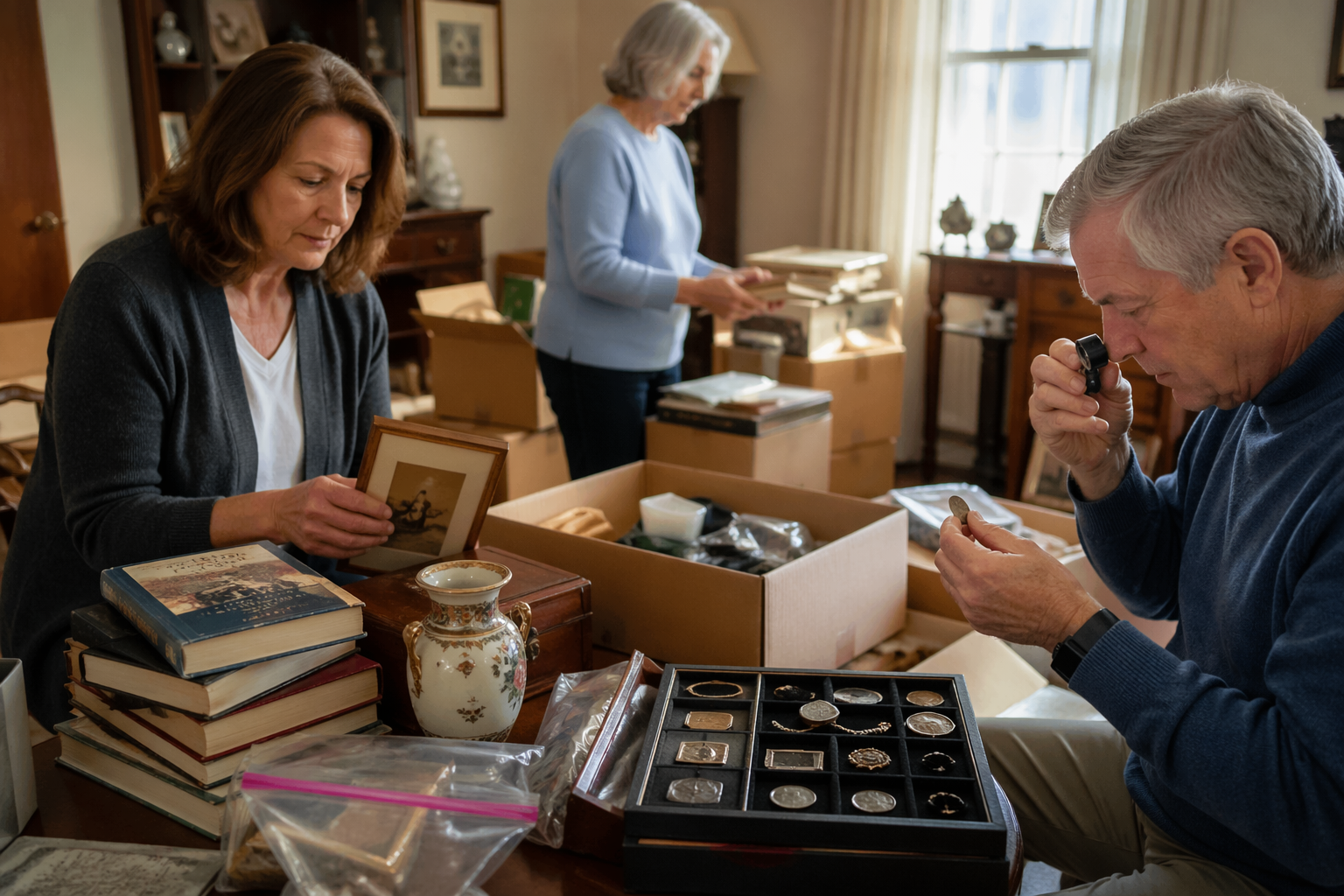
There are few tasks in life as emotionally complicated as cleaning out a parent's home.
It doesn't matter if you've had time to prepare or if it happened suddenly. It doesn't matter if the house is a one-bedroom condo or a four-bedroom colonial packed with 50 years of living. The moment you walk through the door and start sorting through someone else's lifetime of belongings, the weight of it hits differently than almost anything else.
You're not just moving boxes. You're making decisions about memory, identity, and legacy — often while you're still grieving, often under time pressure, and often with siblings or other family members who may see things very differently than you do.
This guide is written for Maryland families who are in that exact moment. We'll walk you through the practical steps, help you navigate the emotional landmines, and show you how to handle the question that trips up almost every family: what do we actually do with all of this stuff?
First: Give Yourself Permission to Go Slowly
The instinct, especially when there are legal deadlines or a home to sell, is to just get in there and power through. Resist it, at least at first.
Every item forces a micro-decision, and each one costs emotional energy. Grief suppresses the prefrontal cortex — your decision-making center — while your emotional center runs hot. You are literally making hundreds of decisions a day with a brain that isn't fully equipped for it. Good Grief
While it may be tempting to dive in and start cleaning out a room or finding those special items you want to keep, it's important to start slow. Taking an initial tour of the house or apartment will help you process and defuse your emotions before anything is permanently touched. Dumpsters.com
That first walk-through isn't about making decisions. It's about getting the lay of the land — mentally cataloguing what's there, identifying areas that will need more time and care, and giving yourself a chance to just be in the space before the work begins.
Secure the Property First
Before sorting a single item, take care of the basics.
Unfortunately, some people will take advantage of a family during a vulnerable time. There could be several spare keys floating around and in the hands of the wrong people. Bye Junk Change the locks as soon as you have legal authority to do so. If your parent lived alone and neighbors or outside caretakers had keys, this is especially important.
Also gather essential documents early. Before throwing away any papers, find and put aside your parent's will, trusts and addenda; life insurance policies and statements; real estate deeds and titles; recent bank statements; stock certificates; 401(k) records; and tax returns. Next Avenue These can be scattered throughout a home — in filing cabinets, desk drawers, boxes in closets, even tucked inside books. Do a thorough sweep before anything else gets moved.
The Four-Box Method: Keep, Sell, Donate, Discard
Once you're ready to start sorting, the most effective approach most professional organizers recommend is working room by room with a clear system. As you move through the home, use four categories: keep, donate, sell, and discard. Caily
Here's how to think about each one:
Keep — Items that have genuine sentimental or practical value to family members. The goal here isn't to keep everything with a memory attached — that way lies a house full of boxes you'll never open. Be selective. Ask yourself honestly whether you'll display it, use it, or cherish it — or whether you're keeping it out of guilt.
Donate — Items in good, usable condition that someone else could genuinely benefit from. One way to ease the difficult emotions during this work is to give practical objects to people who could use them. In donating, you're honoring your loved one's memory by giving those everyday items a new purpose. Empathy Maryland has a strong network of donation resources including Habitat for Humanity ReStores (which accepts furniture and building materials), Vietnam Veterans of America (which offers free pickup), and local shelters that often need bedding and kitchen items.
Sell — Items that have monetary value and deserve more than a donation bin. This category is where families consistently leave money on the table, either by not recognizing value or by choosing convenience over a fair return. More on this shortly.
Discard — Broken furniture, old magazines, expired items, mystery cables, anything that has no remaining use or value. This is where a dumpster rental or junk removal service earns its cost.
The Category Families Get Wrong Most Often: Sell
Here's the honest truth that most estate cleanout guides dance around: the "sell" category is where families make their biggest mistakes.
It's understandable. When you're exhausted and grieving and just want the process to be over, selling things individually feels like an enormous extra burden. So things get donated, or given away in bulk, or simply thrown out — and valuable items disappear without anyone realizing what they were worth.
Professional estate evaluators consistently report notable findings nationwide. Valuable coins hide in coffee cans, jewelry boxes, and storage containers. Previous generations saved these coins without knowing their future worth. Mvcoinshop The same is true of jewelry, silverware, watches, and collectibles.
Here are some of the most commonly overlooked valuables in Maryland homes:
Coins — Pre-1965 U.S. dimes, quarters, and half dollars are 90% silver and worth significantly more than face value at today's silver prices. Morgan and Peace silver dollars, gold coins, and any collection stored in a folder, album, or velvet-lined box should be looked at by a professional before anything else is decided. A coffee can of old change could easily contain $200–$500 in silver alone.
Gold and Silver Jewelry — If a piece looks like it is made from a precious metal, check for tiny markings. A silver brooch may have a "925" mark; a gold ring may have a "10K," "14K," or "18K" stamp. Mearto Even broken or mismatched jewelry has melt value. A tangled pile of gold chains that looks like costume junk could be worth hundreds of dollars in gold content alone.
Sterling Silverware — Full or partial sets of sterling silver flatware, tea sets, and serving pieces are among the most consistently valuable items in older Maryland homes. Look for "Sterling" or "925" stamped on the back of pieces. Silver-plated items (marked "EPNS" or "Silver Plate") have little melt value but may still be collectible depending on the maker.
Vintage Watches and Pocket Watches — Vintage and antique watches, including pocket watches and wristwatches from well-known brands, can hold significant value. Evaluating the authenticity, condition, and appraisal of timepieces is crucial. True Legacy Homes A pocket watch from a grandfather's dresser drawer could be worth anywhere from $50 to several thousand dollars depending on the maker and condition.
Sports Memorabilia and Trading Cards — Autographed items, vintage baseball cards in original condition, and game-worn equipment can be genuinely valuable. Condition is everything — cards stored in binders or boxes in climate-controlled rooms hold their value far better than those left loose in a shoebox.
Art Pottery and Ceramics — During the late 1800s and early 1900s, art pottery became a popular collectible in American homes. Some notable manufacturers to look for include McCoy, Frankoma, and Roseville. One Roseville Pottery piece sold for over $38,000. LoveToKnow
Old Books — Always check to see if a book is signed. Even if you're not familiar with the author, a signed copy can be valuable. LoveToKnow First editions of classic American literature, signed copies, and books from notable presses can be worth serious money to the right collector.
Stamps and Paper Ephemera — Stamp collections are easy to overlook and easy to undervalue. Many stamps are worth a few dollars, but some are actually worth millions. Some of the most valuable stamps feature important people or events. LoveToKnow Old stock certificates, historical documents, and vintage paper items can also have collector value.
The rule across all of these: don't sell, donate, or discard anything you don't fully understand yet. Set it aside. Get an expert opinion before it leaves the house.
Managing Family Dynamics
If you have siblings, the cleanout process adds a layer of complexity that no logistics guide fully prepares you for.
Calculation creeps up with stealth and changes the tenor of the process. It's first detected when the sister who admired the dishes suddenly starts waxing poetic about the sterling silver, or when the brother who remembered when Dad bought the watch suddenly recalls being with him when he bought the gold cuff links. Slate
Grief, memory, and money are a complicated mix. A few approaches that help:
Have family members create wish lists first before anyone takes anything. Have your siblings create a wish list of items they'd like from the estate. Then try to divide the assets equally by monetary value, which you'll know through appraisals. Next Avenue
Use a rotation system for sentimental items. Take turns picking one item at a time. Draw numbers for who goes first. It's not a perfect system, but it's transparent.
Separate the legal from the emotional. Items with real monetary value should be appraised before anyone claims them — not after. It's much easier to divide things fairly when everyone has the same information about what things are actually worth.
Bring in a neutral party when needed. Bring someone who isn't grieving as hard as you are — a friend, a cousin who wasn't as close — someone who can hold up a bread maker and say "keep or donate?" without it triggering a 20-minute memory spiral. Good Grief
Pacing Yourself: This Is a Marathon, Not a Sprint
Set a timer. Work for 2–3 hours, then stop. Eat something. Go outside. Come back tomorrow. Marathon sessions lead to regret — you'll throw away something you wanted or keep 14 boxes of things you'll never look at again. Good Grief
It also helps to photograph rooms and items before anything is moved. This gives you a record of what was there, helps with insurance and estate documentation, and lets you preserve the memory of certain items even if you ultimately decide not to keep the physical object.
Photograph items before donating or selling them to preserve the memories without keeping the physical object. When tackling the cleanout, work room by room to keep progress visible and prevent feeling scattered. Caily
Give yourself permission to create a "not sure" box. Not every decision has to be made on the spot. Set ambiguous items aside, give yourself two weeks, and revisit them with fresh eyes.
Where Sanford & Son Fits In
At Sanford & Son, we specialize in exactly the part of this process that most families find hardest: figuring out what the "sell" category is actually worth, and getting paid fairly for it without the hassle of listing things, meeting strangers, or driving across Maryland to a coin shop or jewelry store.
We come to you. Our experts visit your home anywhere in Maryland, review coins, jewelry, collectibles, antiques, and estate contents on the spot, explain what we're seeing in plain language, and make a fair cash offer. You don't have to know what you have — that's our job. We're licensed, bonded, and insured, and we're a member of the Numismatic Guaranty Company (NGC).
Whether you've found a single box of coins that needs looking at, or you're managing an entire home full of decades-old belongings, we'll give you a straight answer and a fair offer — with no pressure, no obligation, and no strangers coming to your home to buy things one at a time off Craigslist.
A Final Word
Cleaning out a parent's home is hard in ways that are difficult to fully describe until you're in it. There is no perfect way to do it, no timeline that works for everyone, and no system that eliminates the grief underneath the logistics.
What we can tell you is this: take your time with the sentimental decisions, be practical and methodical with the organizational ones, and don't let exhaustion or urgency cause you to give away things that have real value before you understand what you're giving away.
You don't have to figure all of this out alone.
Ready for Help with the "Sell" Category?
If you're in the middle of a Maryland estate cleanout and need a trusted expert to come evaluate coins, jewelry, collectibles, and other valuables — we're ready when you are.
📞 Call or text: (410) 746-5090 Open 7 days a week, 7am–7pm
🌐 Contact us online: sanfordandsoncoins.com/contact-us.html
We'll come to you, tell you what you have, and make you a fair offer — on the spot. No pressure. No obligation. No strangers at your door.
Sources: Good Grief Relief; Dumpsters.com; Next Avenue; Caily.com; LoveToKnow; Mearto; Slate; American Brain Foundation; Habitat for Humanity; Vietnam Veterans of America
Frequently Asked Questions
How long does it typically take to clean out a parent's home?
There is no universal timeline, and anyone who tells you otherwise is underselling the complexity. A modest home with limited contents and a single decision-maker might be manageable in a focused week. A larger home filled with decades of belongings, multiple family members with competing views, and items that need professional appraisal before any decisions can be made could realistically take a month or more. The more important variable isn't the size of the house — it's your emotional bandwidth. Trying to rush the process to meet an arbitrary deadline is one of the most common causes of regret. If the home needs to be sold on a specific timeline, work backwards from that date and give yourself more time than you think you'll need for the early sorting stages.
Do I need to hire a professional estate appraiser before selling anything?
For most everyday household items — furniture, clothes, kitchen goods, basic décor — a professional appraisal isn't necessary. But for any item that might have collector or precious metal value, getting an expert opinion before selling is strongly advisable. This includes all coins (especially anything pre-1965 or in a labeled collection), all jewelry (especially pieces marked with gold or silver content), silverware sets, vintage watches, artwork, and any items that look old and unfamiliar. The cost of a professional appraisal is almost always justified by what it protects you from — which is selling a $1,000 item for $20 because you didn't know what it was.
What's the difference between an estate sale and selling to a buyer like Sanford & Son?
An estate sale involves opening your parent's home to the public over one or more days, pricing items individually, and having strangers walk through the property. Estate sale companies typically charge 25–40% commission on everything sold, and unsold items remain your responsibility afterward. Selling to a mobile in-home buyer like Sanford & Son means a single appointment, a private evaluation, and an on-the-spot cash offer — no public access to the home, no commission, and no leftover inventory to manage. For families who value privacy, simplicity, and speed, the in-home buyer model is often a better fit than an estate sale.
Should I sort everything before calling a buyer?
No — and in fact, sorting too aggressively before getting an expert opinion is one of the biggest mistakes families make. You may unintentionally discard or donate something valuable while trying to "clean up" before a visit. Call us first. We'll do an initial walkthrough and help you understand what deserves a closer look before you commit to any decisions about what leaves the house.
What items does Sanford & Son buy during an in-home visit?
We buy coins (U.S. and foreign, silver, gold, and collectible), gold and silver jewelry, sterling silverware, vintage watches and pocket watches, sports memorabilia, antiques, collectibles, and general estate contents. We're generalists with deep expertise — we're not limited to one category, which means one appointment can cover the full range of what you're looking at.
What happens to items you don't buy?
We'll give you honest guidance on what the remaining items are worth and the best options for each — whether that's donation, a different type of buyer, or another disposal path. We're not here to take everything at a lowball price just to clear the house. We'd rather give you a fair picture of your options and let you make an informed decision.
Is it okay to sell things before probate is settled?
This depends on your state's laws and the specifics of the estate. In Maryland, the executor of an estate has the legal authority to manage and sell estate assets, but it's important to act within the boundaries of the probate process. If you're not the executor, you should confirm your authority to sell before entering into any transactions. When in doubt, consult the estate attorney handling the probate before selling significant items — especially coins, jewelry, and anything else with meaningful monetary value.
How do I handle items that have sentimental value to multiple family members?
This is one of the most common and most delicate challenges in any estate cleanout. The approach that creates the least conflict is to address sentimental items as a group, with all interested family members present, before any individual decisions are made. Use a rotation system — take turns picking one item, with the order determined randomly or by some agreed-upon method. For items with both sentimental and monetary value, have them appraised first so that any division of assets can be done with accurate information rather than assumptions. And when emotions run high, don't force decisions in the moment — set the item aside and come back to it.
