

Most people who call us about a coin collection say some version of the same thing: "I don't really know what I have. My grandfather collected coins for forty years and I don't know where to begin."
That uncertainty is completely understandable. Coin collecting — numismatics, to use the formal term — is a discipline that professionals spend decades learning. The gap between what a coin looks like and what it's actually worth can be enormous, and it runs in both directions: a coin that looks impressive might be common, and a coin that looks unremarkable might be genuinely rare.
What we want to do in this post is open the process up completely. When Sanford & Son sits down with a coin collection, what are we actually looking for? What tools do we use? What makes one coin worth $30 and an identical-looking coin worth $3,000?
If you understand the framework, you'll know what questions to ask, what to protect, and what you're actually dealing with when you pick up the phone.
The Two Foundational Questions
Before anything else, a good appraiser is asking two questions simultaneously:
1. What is this coin's melt value? — The floor. The minimum the coin is worth based purely on its precious metal content, regardless of any collector premium. Every coin containing gold or silver has a melt value tied to daily precious metal prices, and no legitimate offer should fall below it.
2. What is this coin's numismatic value? — The ceiling potential. What collectors are actually paying for this specific coin in this specific condition, based on its rarity, grade, date, mint mark, and current market demand.
For some coins, these two numbers are virtually identical — a common-date silver dollar in circulated condition is worth its silver content, give or take. For other coins, the numismatic premium towers above the melt value. A 1916-D Mercury dime contains about $2 worth of silver. The same coin in Fine condition is worth thousands of dollars because its mintage was only 264,000 — one of the lowest in the entire Mercury dime series.
The appraiser's job is to correctly identify where each coin falls on that spectrum.
Step One: Identification
Before a value can be assigned to anything, the coin has to be correctly identified. This sounds obvious, but it's where the most costly mistakes happen when people try to assess collections themselves.
A Morgan dollar is a Morgan dollar. But which Morgan dollar? The 1881-S in MS-65 is worth around $300. The 1889-CC in the same grade is worth over $30,000. Both are Morgan dollars. Both look like Morgan dollars. The difference is entirely in the date and mint mark — and it's the difference between a solid silver coin and a coin that belongs in a serious collector's portfolio.
A high or low mintage number is one of the key factors that determines the value of a coin. Each mint produces a different number of coins each year, making some years and mint marks rarer than others. For example, in 1909, the Philadelphia Mint made over 100 million Wheat cents, while the San Francisco Mint only minted about 2.3 million. Money Blog
The identification step covers:
Date — The year the coin was struck. Some years are dramatically more valuable than others within the same series. In the Mercury dime series, a 1916-D is a major rarity. A 1942 is extremely common.
Mint Mark — The small letter indicating which U.S. Mint facility struck the coin. "D" is Denver, "S" is San Francisco, "O" is New Orleans, "CC" is Carson City, and no letter (or "P") is Philadelphia. Certain Carson City mint issues are prized today not because they are the oldest, but because fewer were struck. Hallmark Rare Coins The mint mark can change the value of a coin by a factor of 10 or more within the same date and series.
Series and Design Type — Identifying whether you have a Morgan dollar or a Peace dollar, a Mercury dime or a Roosevelt dime, a Barber quarter or a Standing Liberty quarter. Each series has its own value hierarchy, key dates, and grading standards.
Die Varieties — Within a single date and mint mark, coins can exist in multiple varieties created by different die preparations. In the case of 1909 cents, each mint began producing them with the initials VDB at the bottom of the reverse. Not long after production began, the decision was made to remove the initials moving forward. The VDB pieces are worth more because fewer were minted. There are also additional 1909 varieties, including the S over horizontal S and doubled die obverse, that many casual collectors are unaware of. Money Blog
A professional appraiser goes through this identification process for every coin in the collection that might have meaningful value — checking reference guides, population reports, and current auction data as needed.
Step Two: Grading — The Most Consequential Factor
Once a coin is correctly identified, grading determines its condition — and condition is where most of the value lives in any collection.
Coin grading is the process of determining the grade or condition of a coin, one of the key factors in determining its collectible value. A coin's grade is generally determined by five main components: strike, surface preservation, luster, coloration, and eye appeal. Wikipedia
The universal language of coin grading is the Sheldon Scale, a 70-point numeric system developed by Dr. William Sheldon in 1948. In 1948, Dr. William Sheldon developed the Sheldon Scale, assigning grades from 1 through 70 to coins. The basis of Sheldon's theory was that a 70 would be worth 70 times as much as a 1. PCGS While the math no longer works out so neatly across all series, the scale remains the universal standard.
Here's what each zone of the scale represents and what a buyer is evaluating within each:
Circulated Grades (1–58): Measuring Wear
For circulated coins — coins that passed through commerce and show evidence of use — the primary grading variable is how much of the original design detail has been lost to wear.
Poor (P-1) through About Good (AG-3): Barely identifiable. Major design elements are outlines only.
Good (G-4 to G-6): Heavily worn, but date and major design visible. Mostly valued at melt.
Very Good (VG-8 to VG-10): Moderate wear. Most major details present.
Fine (F-12 to F-15): Even wear throughout. All major design elements clear.
Very Fine (VF-20 to VF-35): Light to moderate wear on high points. Considerable detail remaining.
Extremely Fine (EF/XF-40 to EF-45): Slight wear on highest points only. Nearly full detail present.
About Uncirculated (AU-50 to AU-58): Barely perceptible wear. The distinction between AU-58 and MS-60 is one of the most consequential in all of numismatics — the price difference can be 2x to 10x or more. AU-58 shows the barest trace of friction on the absolute highest point, with nearly full luster — this is the "slider" grade, extremely close to Mint State. US Coin Shows
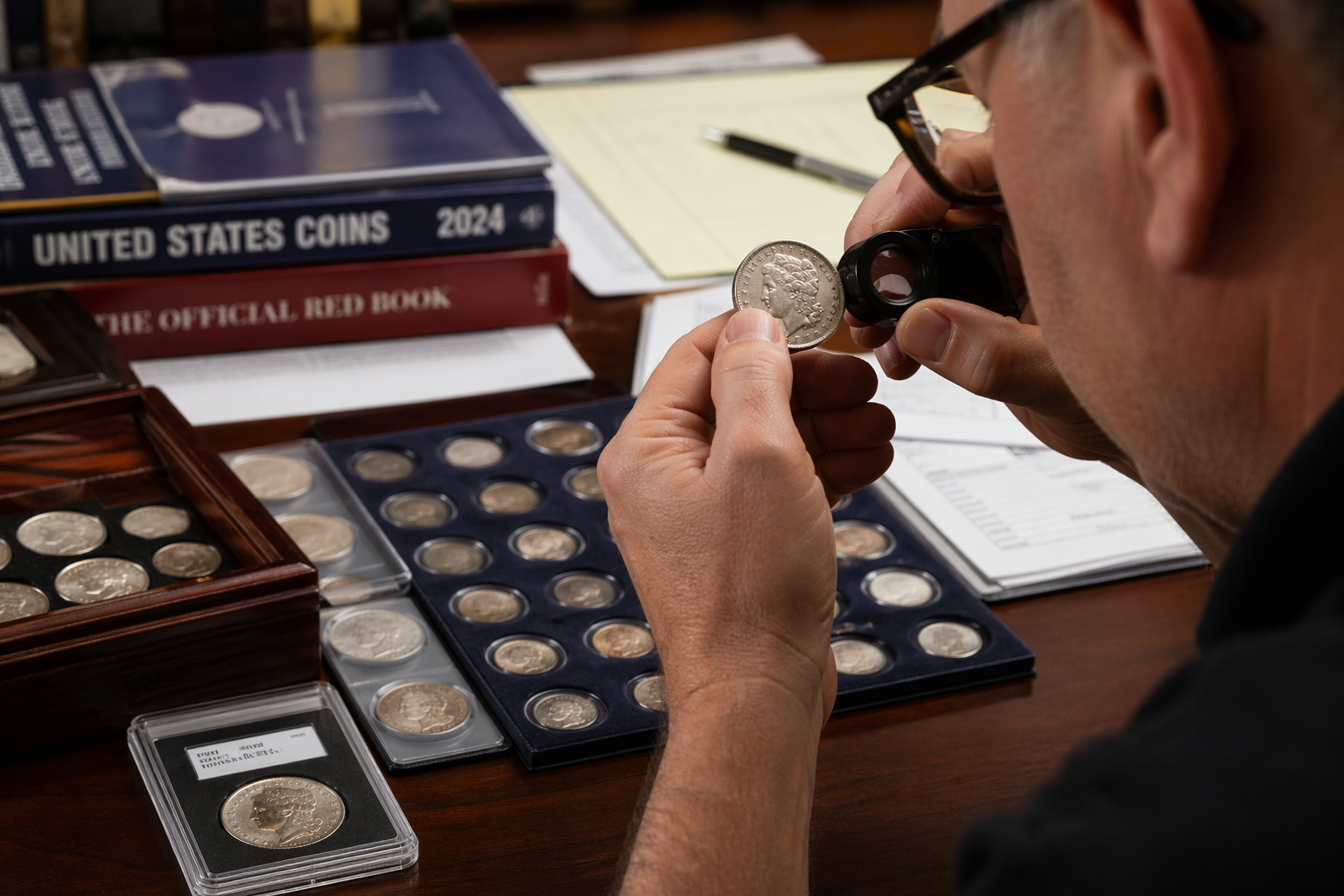
When grading circulated coins, a professional examines each coin under good lighting with a loupe — typically 5x to 10x magnification. They're looking at the high points of the design where wear first appears: Liberty's cheek and hair on Morgan dollars, the eagle's breast and wing tips on Walking Liberty halves, Lincoln's portrait on wheat cents.
Mint State Grades (MS-60 to MS-70): Measuring Surface Quality
Mint State coins show no evidence of circulation wear whatsoever. The differences within Mint State grades are determined by the quality of the strike, luster, severity and location of contact marks, and most importantly, the general eye appeal of the piece. Money Blog
MS-60 to MS-62: No wear, but often unattractive. Heavy bag marks and dull or impaired luster.
MS-63 to MS-64 (Choice Uncirculated): Better surfaces with fewer marks. Above-average appearance. Most commonly graded Mint State coins fall here.
MS-65 to MS-66 (Gem Uncirculated): High eye appeal, minimal marks, above-average or full luster. An MS-66 graded coin should have above average eye appeal and be considered attractive for the issue. A few small scattered marks may be present, but not a single large obvious mark that detracts from the overall appeal. PCGS
MS-67 to MS-69: Near-perfect coins with exceptional eye appeal. Rare for older series; commanding significant premiums.
MS-70: The perfect coin. Has very attractive sharp strike and original luster of the highest quality for the date and mint. No contact marks are visible under magnification. There are no noticeable hairlines, scuff marks, or defects. Eye appeal is attractive and outstanding. American Numismatic Association Effectively impossible for most older U.S. coins.
The Five Elements Graders Examine
Within those broad grade categories, a professional evaluator is specifically assessing five distinct attributes:
1. Strike Quality
Strike refers to how well the coin's design was impressed onto the planchet when it was manufactured. A sharp, full strike captures every detail of the design — the hair strands, the feathers, the lettering. A weak or soft strike leaves design elements mushy or incomplete.
Strike is a primary grading factor. How well the coin was struck by the dies affects the sharpness of details. GOVMINT For certain series, a designation for a full, sharp strike carries meaningful premium — "Full Bands" for Mercury dimes, "Full Bell Lines" for Franklin half dollars, "Full Head" for Standing Liberty quarters. These are coins where the central design detail struck up sharply, which is harder to find than it sounds.
2. Surface Preservation
Surface preservation means the presence or absence of marks, scratches, contact marks from other coins, and environmental damage on the coin's surface. Every mark has a story — coins banged around in mint bags, rubbed against each other in circulation, stored in envelopes that caused subtle abrasions.
Grading professionals use magnifiers typically at 5x or 10x to detect fine details like micro-scratches, die-polishing marks, cracks, and mint errors. Magnification tools ensure every detail is scrutinized for consistency with coin grading standards. GOVMINT
The location of marks matters as much as their severity. A contact mark in an open field — the smooth area of a coin's surface away from the design — is less damaging to a grade than the same mark on Liberty's cheek, which is the focal point every viewer's eye travels to first.
3. Luster
Luster is the reflective quality of a coin's surface, created by the flow of metal during the minting process. Fresh-from-the-mint coins exhibit a distinctive "cartwheel" effect — a swirling pattern of light across the surface when the coin is rotated under a direct light source. Coins that hold a bright, unbroken luster earn higher coin grades. Coins lose sharpness and detail as they circulate. GOVMINT
Original luster is fragile. It can be destroyed by cleaning, improper storage, excessive handling, or even exposure to certain types of paper in old coin albums. A coin that has been "dipped" — chemically stripped of surface toning — often shows artificially bright surfaces that lack the genuine cartwheel effect of original luster, and professional graders recognize this immediately.
This is why the universal rule applies: never clean your coins. Cleaning destroys original surfaces and leaves evidence that professional graders can spot with certainty. A cleaned coin that might have graded MS-63 with original luster may be designated "Cleaned" by NGC or PCGS, which effectively marks it as damaged goods and dramatically reduces its value.
4. Coloration and Toning
For copper coins, color is a primary grading element — red (RD), red-brown (RB), and brown (BN) designations reflect how much original copper luster remains. A 1909-S VDB cent in MS-65 Red is worth dramatically more than the same coin in MS-65 Brown.
For silver and gold coins, natural toning that develops over decades can actually enhance a coin's value when it's attractive. NGC reserves its star designation for coins with exceptional eye appeal for a given grade, which includes attributes like colorful toning, intense luster, or especially strong cameo contrast in the case of Proof coins. APMEX A Morgan dollar with original, attractive rainbow toning can command a significant premium over an untoned coin of the same grade.
Artificially induced toning — toning that has been chemically applied to a coin to make it appear aged — is detectable by experienced graders and results in coin being labeled as "Questionable Color" or "Artificial Toning," destroying any premium.
5. Eye Appeal
Eye appeal is the most subjective element of grading, but it is recognized and quantified by professional services. Eye appeal either adds or subtracts from the technical grade. PCGS uses seven levels of eye appeal for toning, from "Amazing" to "Ugly," and six levels for luster on mint state coins, from "Amazing" to "Negative." PCGS
A coin with exceptional eye appeal — one that makes you look twice and say "wow" — can receive a designation that adds value beyond its technical grade. Conversely, a coin with all the right technical numbers but poor eye appeal (dull surfaces, unattractive toning, a disappointing strike) may not achieve its theoretical grade potential.
Eye appeal is where years of experience matter most. It's difficult to teach and impossible to quantify precisely — it's the judgment that comes from having examined tens of thousands of coins and developing a feel for what truly exceptional looks like.
Step Three: Market Comparison
Once a coin has been identified and graded, the appraiser needs to know what the market is currently paying for it.
Once the coins have been graded, the appraiser will compare them to similar items in the current market. This involves looking at past sales, auction results, and other data to understand what buyers currently pay for similar coins. USPS
The resources professionals use include:
PCGS Price Guide and NGC Price Guide — Comprehensive databases of current retail values for coins in every grade, updated regularly. These represent what dealers are selling coins for — a useful ceiling reference.
Heritage Auctions, Stack's Bowers, and GreatCollections archives — Real-world sale records showing what coins in specific grades actually sold for in recent auctions. For rare or high-value coins, recent comparable sales are the most relevant data point.
PCGS and NGC Population Reports — These databases show how many examples of a given coin in a given grade exist in certified holders. A coin graded MS-65 where only five examples are known at that grade or above is a different proposition than a coin graded MS-65 where 2,000 examples exist. Population estimates are often more important than original mintage numbers for determining actual scarcity and value. Gainesville Coins
Current precious metal prices — For all silver and gold coins, the melt value calculation is updated against daily spot prices. With gold currently around $4,700 per ounce and silver around $75+ per ounce, the floor values for precious metal coins are historically high.
The Hidden Variables That Change Everything
Beyond the standard grading factors, several circumstances can dramatically change a collection's value in ways that a first-time seller would never anticipate:
Key Dates Hidden in Common Series
Certain date and mint mark combinations were produced in very low numbers. For example, a common 1916 Mercury Dime is worth about $2, but a 1916-D (Denver Mint) is a major rarity worth thousands. We help heirs and executors identify these specific keys so they aren't sold at bulk silver prices. American Rarities
The same principle applies across nearly every U.S. coin series. A collection of Lincoln cents might be worth $10 in common dates — or $2,000 if one of those cents happens to be a 1909-S VDB or a 1914-D. Without knowing what to look for, those coins look identical to everything else in the folder.
Key dates to recognize across major series include:
- Lincoln Cents: 1909-S VDB, 1909-S, 1914-D, 1922 Plain (no D), 1931-S
- Buffalo Nickels: 1913-S Type 2, 1915-S, 1921-S, 1926-S
- Mercury Dimes: 1916-D, 1921, 1921-D, 1926-S
- Walking Liberty Half Dollars: 1916-S, 1921, 1921-D, 1921-S
- Morgan Dollars: 1893-S, 1895, 1889-CC, 1893-CC, 1901
- Peace Dollars: 1921, 1928
Error Coins and Die Varieties
Minting errors — doubled dies, off-center strikes, wrong-planchet coins — can transform an ordinary coin into a significant rarity. The 1955 Lincoln cent doubled die, where the date and lettering appear doubled to the naked eye, can be worth $500–$10,000+ depending on grade. A 1943 copper cent (struck on leftover copper blanks when the mint switched to steel) can be worth over $100,000.
Even subtle die varieties — overdates, repunched mint marks, die cracks — are catalogued and carry collector premiums. An experienced appraiser examines suspect coins under magnification looking for these anomalies before assigning any value.
Certified vs. Raw Coins
A coin already certified and graded in an NGC or PCGS holder provides significant advantages in any transaction. Coin grading is the process of evaluating a coin's physical characteristics — wear, strike quality, luster, and eye appeal — and assigning it a numerical grade, typically on a 70-point scale. This grading is often performed by third-party certification services like PCGS, NGC, or ANACS, and results in the coin being encapsulated in a tamper-evident holder. Keywell Collectibles
A certified coin's grade is documented, its authenticity guaranteed, and its value supported by real auction comparables at that grade. For any coin where the difference between grades represents meaningful money, professional certification is worth considering before sale.
The Appraisal vs. The Offer
One distinction worth understanding: a formal coin appraisal for insurance or estate purposes values coins at replacement cost — what you'd pay to replace them at retail. A buyer's offer is based on what the buyer will pay — typically a percentage below retail that accounts for the buyer's margin, time, and cost of resale.
When receiving an appraisal for insurance or estate planning, you are normally seeking replacement value for the collection. When selling coins, the evaluation or appraisal will be the amount a dealer would pay. Depending on the type of coins, dealer bids are normally between 80–95% of the retail value. Grand Rapids Coins
A reputable buyer will be transparent about this distinction and explain exactly how they arrived at their offer.
What Separates a Fair Appraisal from an Unfair One
The simplest test: a fair appraiser shows their work.
They tell you what the coin is (series, date, mint mark), what grade they've assigned and why, what the current retail value is at that grade, and what they're offering as a percentage of that value. They explain any exceptions — why a key date is being identified separately from common dates, why an error coin is being set aside for closer examination, why a cleaned coin is receiving a lower offer.
What an unfair appraisal looks like: a single number with no explanation, a flat "per-coin" or "per-ounce" offer that doesn't distinguish between a key date and a common one, an offer made without the buyer examining the dates and mint marks on individual coins.
The coin appraisal should not only be free of charge, but it should also be a no-obligation evaluation. Even if you get the slightest hint that the motives of the coin dealer you're working with may not be sincere, you're best moving on until you find a coin dealer you're comfortable with. Atlanta Gold and Coin
How Sanford & Son Approaches a Collection
When we sit down with a coin collection, the process follows exactly what we've described above. We work through coins systematically — identifying each series, checking dates and mint marks against key date references, grading significant coins using a loupe under good lighting, pulling out anything that might be an error or variety for closer examination.
We reference current PCGS and NGC price guides alongside recent auction comparables. We calculate melt values against current precious metal spot prices for every silver and gold coin. We distinguish clearly between common dates worth melt value and key dates worth collector premiums.
We're a member of the Numismatic Guaranty Company (NGC) — which means we operate within the professional standards of the industry's most recognized grading authority. And we explain every offer we make. You'll know what we found, why it's worth what we say it's worth, and how we arrived at the number.
There's no pressure to sell anything, and no obligation attached to the evaluation. If you want to think about it, get a second opinion, or hold onto certain coins, we'll respect that completely.
Ready to Have Your Collection Appraised?
Whether you've inherited a collection you know nothing about, built a collection over decades and are ready to sell, or just want a professional set of eyes on what you have before making any decisions — we'd love to take a look.
Sanford & Son visits homes anywhere in Maryland. Our coin appraisals are free, no-obligation, and conducted at your home — no need to transport anything.
📞 Call or text: (410) 746-5090 Open 7 days a week, 7am–7pm
🌐 Contact us online: sanfordandsoncoins.com/contact-us.html
One visit. Expert eyes. Fair offer tied to real market data.
Frequently Asked Questions
What's the difference between an appraisal and a grading service like NGC or PCGS?
A coin appraisal is a professional evaluation of a coin's estimated market value. Appraisers look at multiple factors — condition, rarity, demand, and current market trends — to determine what the coin could reasonably sell for in today's market. Coin grading, by contrast, is the process of evaluating a coin's physical characteristics and assigning it a certified numerical grade, typically encapsulating the coin in a tamper-evident holder. Keywell Collectibles An appraisal tells you what a coin is worth. A grade certifies its condition for the broader marketplace. For most collection evaluations before a sale decision, a professional appraisal is the appropriate first step. Grading makes sense for individual coins where the condition difference is meaningful and the cost of grading is justified by the upside.
Should I get my coins professionally graded before selling?
The biggest misconception about grading is that grading a coin makes it automatically worth more than if it were ungraded. If you have a nice-looking coin, it doesn't become worth more just because PCGS certifies it. All that does is make the coin easier to sell. There are certain extreme levels where a coin gets an especially high grade and it is suddenly worth much more than if it was ungraded. Coinappraiser Our general guidance: for coins where the potential value is $500+, professional grading is often worth the $20–$50 cost. For common-date silver coins worth $30–$60 at melt, grading isn't necessary.
How do I know if I have any key dates?
The best approach is to have an expert look at every coin in the collection — not just the obvious ones — before making any decisions. Key dates don't announce themselves. A 1916-D Mercury dime looks almost exactly like any other Mercury dime to an untrained eye. We check every significant coin in a collection against key date references as part of our standard appraisal process.
What does "cleaned" mean and why does it matter so much?
A cleaned coin has had its surfaces altered — either chemically stripped, polished, or wire-brushed — in an attempt to improve its appearance. Professional graders can identify cleaning through the presence of hairline scratches under magnification, the absence of natural luster flow lines, or unnatural brightness that doesn't match a coin's age. Never, ever clean your coins. Cleaning coins will undoubtedly decrease their value, often drastically. Grand Rapids Coins A cleaned coin that might have been worth $500 in original condition may be worth $50 or less once identified as cleaned by NGC or PCGS.
What is "eye appeal" and why does it affect value?
Eye appeal is the holistic visual impression a coin makes — the combination of its luster, toning, strike sharpness, and surface quality that makes it attractive or unattractive as a specimen. Two coins can have technically identical grades but meaningfully different eye appeal, and the market will pay more for the more attractive example. NGC awards its star (★) designation to coins with exceptional eye appeal at their grade level, which typically commands a premium over the standard price for that grade.
How are melt value and collector value different?
Melt value is the floor — what the metal content of a coin is worth at current precious metal spot prices, regardless of any collector interest. Collector (numismatic) value is the premium above melt driven by rarity, condition, demand, and historical significance. For most circulated common-date silver coins, collector value is close to melt. For key dates, error coins, and high-grade examples, collector value can be many times the melt value. A fair appraisal correctly identifies which coins deserve numismatic premiums and which are priced primarily on metal content.
Can I bring just a few coins, or do you need to see the whole collection?
We're happy to look at any quantity — a single coin you've been curious about or an entire estate collection filling multiple albums and storage boxes. There's no minimum, and no maximum. Our visit is free regardless of scope.
