

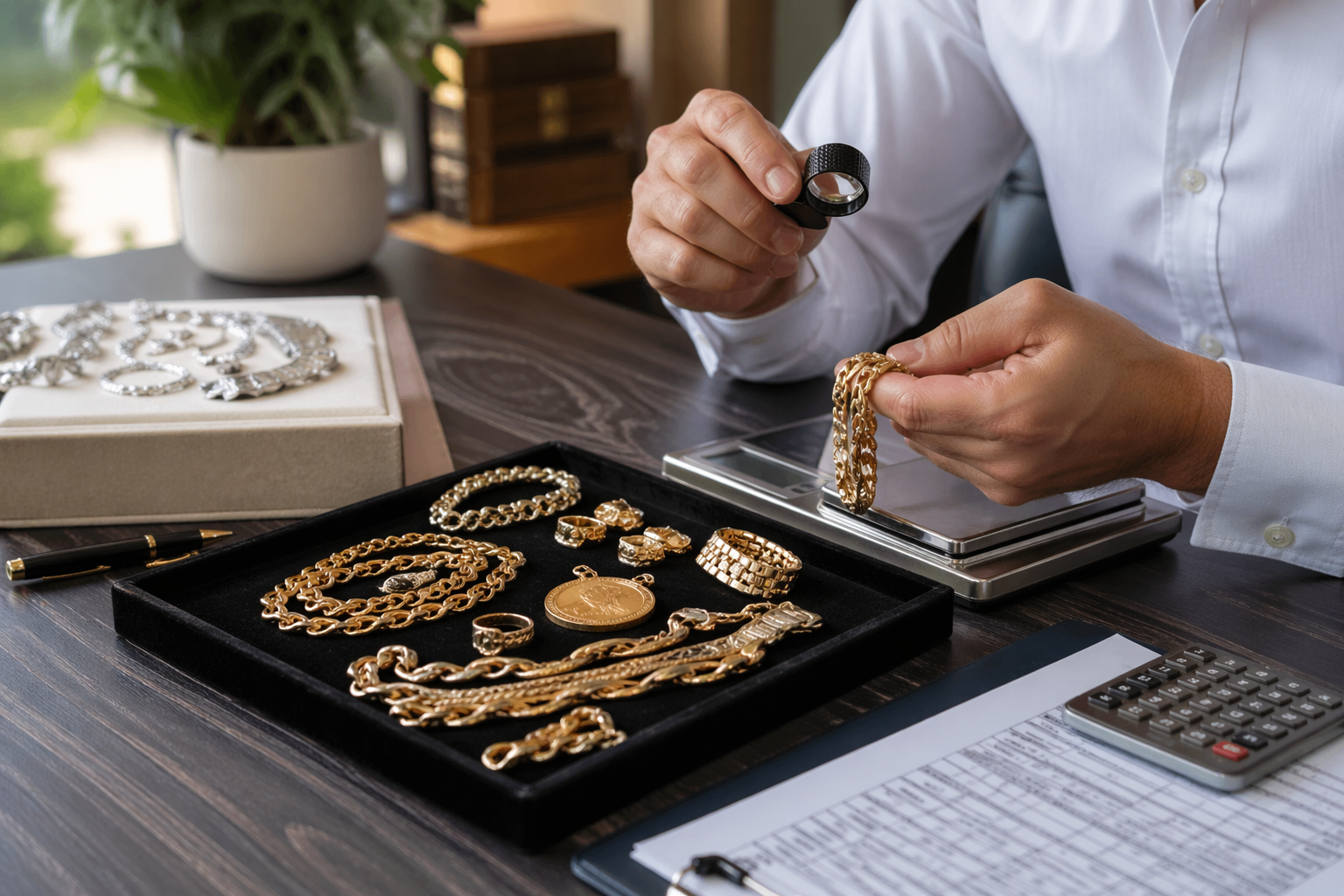
If you have gold or silver jewelry sitting in a drawer — pieces you don't wear, pieces from an estate, pieces from a marriage that ended, or pieces that simply don't fit your life anymore — there has arguably never been a better moment in history to sell them.
That's not marketing language. It's arithmetic.
Gold's all-time high now stands at $5,589.38 per ounce, a record it reached on January 28, 2026. In just 12 months, gold didn't just set new highs — it redefined what a "high" gold price looks like in the modern market. CBS News As of late April 2026, gold is trading around $4,700 per ounce — down from that January peak but still near multi-decade highs by any historical measure. Silver recently stood at $78.94 per ounce — more than a $46 rise compared with one year ago. Fortune
To understand what that means for anyone with gold or silver jewelry to sell, you need to understand how precious metal prices translate directly into the cash offers you receive — and why a buyer whose offers are tied to current market prices will treat you very differently from one who makes arbitrary flat offers.
What's Driving the Surge in Gold and Silver Prices?
The rise in precious metal prices over the past two years hasn't been a single event or a short-term anomaly. It reflects several reinforcing structural forces that analysts believe are likely to remain in place for the foreseeable future.
In 2025, gold's price skyrocketed, going from $2,623 to $4,339 per ounce — a 65% increase in one year — driven by the declining value of the U.S. dollar, concerns about inflation, and geopolitical tensions that pushed investors toward safe-haven assets. Yahoo Finance
Central bank and investor demand for gold is set to remain strong, averaging 585 tonnes a quarter in 2026. Prices are expected to push toward $5,000 per ounce by the fourth quarter of 2026, with $6,000 per ounce a possibility longer term. J.P. Morgan
The silver picture is equally striking. Silver is facing a sixth consecutive annual supply deficit — the Silver Institute pegs the 2026 shortfall at 46.3 million ounces — alongside relentless industrial demand from solar, EV, 5G, and semiconductor manufacturers. JM Bullion That structural supply squeeze, combined with investor interest in silver as a precious metal, has pushed prices to levels not seen in decades.
For anyone holding physical gold or silver in the form of jewelry, coins, or estate items, this market environment has a direct, concrete effect on what those items are worth right now.
How Gold Prices Translate Into What Your Jewelry Is Worth
Here's the mechanism that most people don't fully understand until they've been through the process: the value of gold jewelry is directly tied to the daily spot price of gold. When the spot price goes up, the value of every gold ring, chain, bracelet, and earring in your home goes up with it. When it falls, those values fall too.
The math works like this:
A piece of 14K gold jewelry is 58.3% pure gold (14 parts gold out of 24 parts total). A 10-gram 14K gold chain contains approximately 5.83 grams of pure gold. With gold currently around $4,700 per troy ounce (a troy ounce is 31.1 grams), that 5.83 grams represents about $881 in gold content.
Two years ago, with gold at $2,000 per ounce, that same chain would have contained about $375 in gold. The chain hasn't changed. The market moved — and it moved dramatically in the seller's favor.
If gold prices rise, your jewelry is worth more; if they fall, the resale value will be lower. The spot price directly impacts the value of your jewelry — the higher the price of gold in global markets, the more valuable your gold jewelry becomes, regardless of whether it's in the form of rings, necklaces, or bracelets. Stewartkuperdiamonds
The same logic applies to silver. Sterling silver flatware, silver jewelry, and silver coins all carry a floor value tied to the daily silver spot price. Silver has risen more than $46 per ounce over the past year alone. Fortune That means a sterling silver tea set that weighed 400 grams is worth roughly $600 more today than it was a year ago — for no reason other than market movement.
The Three Karat Levels and What They Mean for Your Offer
Not all gold jewelry is created equal — or rather, not all gold jewelry contains the same percentage of gold. The karat stamp tells you exactly how much:
24K gold is 99.9% pure gold. Rarely used in jewelry because pure gold is too soft, but occasionally found in bullion coins, some decorative pieces, and certain Asian jewelry traditions.
18K gold is 75% pure gold. Commonly found in higher-end jewelry, vintage European pieces, and fine estate jewelry. At current prices, 18K is extremely valuable per gram.
14K gold is 58.3% pure gold. The most common karat in American jewelry from the mid-20th century onward. Engagement rings, wedding bands, chains, earrings — the vast majority of American fine jewelry is 14K.
10K gold is 41.7% pure gold. The minimum karat that can legally be called "gold" in the United States. Lower value per gram but still meaningful at today's prices — especially for heavier pieces.
What does this mean practically? A single 14K gold ring weighing 5 grams contains roughly $445 in gold content at current prices. A heavier piece — a gold bracelet, a wide band, a substantial pendant — multiplies that proportionally. An estate jewelry box with a mix of 14K and 18K pieces can easily represent $2,000–$5,000 in gold content alone, before any collector or gemstone premium is factored in.
What About Silver Jewelry and Sterling Items?
Silver has had a similarly extraordinary run. Silver rose to $76.42 per ounce on April 24, 2026, up 131% compared to the same time last year. TRADING ECONOMICS That kind of move has a dramatic effect on anyone holding sterling silver.
Sterling silver is 92.5% pure silver (marked "925" or "Sterling" on the piece). The formula for estimating melt value is straightforward: weight in grams divided by 31.1 (grams per troy ounce), then multiplied by 0.925 (sterling purity), then multiplied by the current silver spot price.
A 200-gram sterling silver serving tray at today's silver price of approximately $76 per ounce contains roughly $454 in silver content. A year ago, with silver at $33 per ounce, that same tray contained about $196 in silver. The tray is identical. The market doubled its value.
For Maryland families sitting on inherited sterling flatware sets, tea services, candlesticks, or decorative pieces — the timing has rarely been better to understand what those items are actually worth.
Should You Sell Now, or Wait for Prices to Go Higher?
This is the question most people get stuck on. Gold just hit all-time highs. Silver more than doubled in a year. Should you sell now, or hold on to see if prices go even higher?
The honest answer is: nobody knows where prices will go from here. Gold prices are near historic highs, making this a strong time to sell old or unused gold jewelry. Rather than trying to time the absolute peak, many sellers choose to take advantage of today's elevated prices and turn unused pieces into cash. The Alloy Market
Here are the three considerations that should actually drive your decision:
Do you need the money? If unused jewelry represents meaningful cash that could go toward a financial goal — a home improvement, a debt payoff, a college fund contribution — the certainty of today's elevated prices is more valuable than the uncertainty of waiting for potentially higher ones.
Are you holding the jewelry for sentiment or habit? There's a difference between jewelry you deeply love and intend to wear or pass down, and jewelry you're holding onto by default because you never got around to dealing with it. The second category deserves a hard look. A tangled gold necklace in a drawer that hasn't been touched in ten years is not an heirloom. It's an asset.
Is the piece truly gaining collector value, or only metal value? For most estate jewelry and inherited pieces, the value driver is metal content. If the piece isn't gaining numismatic, design, or provenance premium over time — if it's purely a function of the gold price — then the metal price is the primary variable, and that variable is currently in your favor.
Gold prices have reached historic highs. If you have unworn jewelry tucked away, it may be worth far more than you realise. There's no time like the present to turn your gold into something more meaningful — whether that's financial security, a major purchase, or simply the clarity of knowing what you have. Suttons & Robertsons
How a Fair Offer Is Actually Calculated
One of the most important things a seller can understand is how reputable buyers calculate offers — and why the difference between a fair buyer and an unfair one shows up in that calculation.
A fair offer on gold jewelry follows this structure:
- Verify the karat — using visual inspection of hallmarks, and electronic testing tools when stamps are unclear or missing
- Weigh the piece — using precision digital scales, in grams or pennyweights (a common unit in the jewelry trade; 1 pennyweight = 1.555 grams)
- Calculate melt value — weight × purity percentage × current spot price
- Determine the offer — a percentage of melt value, adjusted upward for any collector, designer, or gemstone premium
You can expect trustworthy gold buyers to offer 60% to 90% of the melt value for jewelry. The Alloy Market The exact percentage varies based on the buyer's business model, the type of piece, and market conditions. A dedicated in-home buyer like Sanford & Son — whose business depends on repeat referrals and reputation in a local market — has strong incentive to offer toward the higher end of that range. A pawn shop operating on a loan-spread model has incentive to offer toward the lower end.
What an unfair offer looks like: a flat price per gram that doesn't change with the market, an offer made without testing the metal, or an immediate offer without explanation. If a buyer can't tell you the current spot price and show you how they arrived at their number, that's a signal to get a second opinion.
What Sanford & Son Does Differently
At Sanford & Son, our offers are anchored to live precious metal markets — not to arbitrary flat rates or fixed price sheets that haven't been updated in months. When we visit your home in Maryland, we bring current spot price data with us. Our offer on your gold jewelry reflects what gold is worth today, not what it was worth six months ago when someone last updated a price guide.
We're licensed, bonded, and insured. We're a member of the Numismatic Guaranty Company (NGC). And we come to you — which means you don't have to box anything up, carry it across town, or sit in a pawn shop waiting room wondering if you're about to be lowballed.
We explain our reasoning in plain language. You'll know the karat of each piece, how much it weighs, what the current spot price is, and exactly how we arrived at our offer number. No black boxes. No mysterious flat rates.
A Quick Reference: What Common Pieces Are Worth Right Now
Note: These are approximate melt value estimates at current precious metal prices. Actual offers depend on specific weight, karat, condition, and any collector premium.
A typical 14K gold engagement ring (3 grams): ~$267 in gold content A 14K gold chain (10 grams): ~$890 in gold content An 18K gold bracelet (8 grams): ~$1,145 in gold content A 10K gold ring (4 grams): ~$237 in gold content A sterling silver flatware set (32 pieces, ~800 grams): ~$1,800 in silver content A sterling silver tea set (~400 grams): ~$900 in silver content A pre-1965 silver quarter: ~$14 in silver content A Morgan silver dollar: ~$57 in silver content
These numbers change daily with the market. The point is the order of magnitude — and the gap between what these items would have been worth even two years ago and what they're worth today.
The Window Is Open — But It Won't Stay Open Forever
Precious metal markets don't move in one direction forever. The conditions that have driven gold and silver to historic highs — economic uncertainty, geopolitical tension, inflation concerns, central bank buying — could shift. Prices that seem elevated today could look modest in hindsight, or they could correct significantly.
What we know with certainty is that right now, in April 2026, gold and silver prices are near levels that have rarely been seen in history. If you have gold or silver jewelry, coins, or estate items that you don't intend to keep, the market is currently offering more for those items than it has in living memory.
That window is worth taking seriously.
Ready to Find Out What Your Jewelry Is Worth Today?
Sanford & Son visits homes anywhere in Maryland, evaluates gold and silver jewelry, coins, collectibles, and estate items on the spot, and makes fair cash offers tied to current market prices. No pressure. No obligation. No surprises.
📞 Call or text: (410) 746-5090 Open 7 days a week, 7am–7pm
🌐 Contact us online: sanfordandsoncoins.com/contact-us.html
One visit. Market-based offer. Cash in hand.
Frequently Asked Questions
How exactly does the gold spot price affect what I'll be offered for my jewelry?
The spot price is the global market price for one troy ounce of pure gold at any given moment. Your jewelry's offer is calculated from that price: we determine the karat (purity percentage), weigh the piece, calculate its gold content, and apply the current spot price to get a melt value. Our offer is a fair percentage of that melt value, adjusted upward for any designer, gemstone, or collector premium. When the spot price rises, your offer rises proportionally. This is why today's historic gold prices translate directly into meaningfully higher cash offers than sellers would have received two or three years ago.
How do I know if a buyer's offer is tied to current market prices or an arbitrary number?
Ask them to show their work. A fair buyer should be able to tell you the current gold or silver spot price, the karat of your piece, the weight of your piece, and the calculation that led to their offer. If a buyer quotes you a flat price per gram without showing you the spot price they're working from, or if their rate hasn't changed in months, those are red flags. At Sanford & Son, we walk through the calculation with you on every piece.
Gold is near its all-time high — should I wait to sell in case it goes higher?
Attempting to time the peak of any commodity market is extremely difficult, even for professional traders. What we can say is that current prices are historically elevated, the case for selling unused gold jewelry is strong right now, and the certainty of today's prices is worth something compared to the uncertainty of whether tomorrow's prices will be higher or lower. If you don't need the money urgently, holding quality pieces isn't unreasonable — but for most estate jewelry and pieces you simply don't wear, waiting for a marginal uptick rarely justifies the delay.
What if my jewelry doesn't have a visible karat stamp?
Stamps can wear off over time, particularly on older pieces. Some antique jewelry predates the requirement for karat marking. A missing stamp doesn't mean a piece has no gold content — it means we need to test it. We use electronic gold testing tools that measure purity accurately without damaging the piece. Don't discard any piece that looks like gold before having it tested.
Does silver jewelry follow the same pricing logic as gold?
Yes. Sterling silver jewelry, flatware, and decorative pieces are valued by the same melt value framework: weight × purity (92.5% for sterling) × current silver spot price. With silver having more than doubled over the past year, the timing for selling sterling silver is similarly compelling. The same rules apply: look for "925" or "Sterling" stamps, and have everything tested before making any decisions.
What types of jewelry command more than just melt value?
Pieces with significant gemstones (diamonds, sapphires, rubies, emeralds) may be worth more than their metal content if the stones are genuine and of quality. Designer or brand-name pieces — Tiffany, Cartier, Van Cleef, and similar — often carry premiums above melt. Antique or period jewelry (Art Deco, Victorian, Edwardian) can also command collector premiums. For everything else — plain gold chains, standard rings, mismatched earrings, broken pieces — the melt value is the primary driver.
I have a mix of gold and silver items from an estate. Can you evaluate everything in one visit?
Yes. A single Sanford & Son visit covers gold jewelry, silver jewelry, sterling flatware and serving pieces, coins (including pre-1965 silver and gold coins), and other collectibles and estate items. You don't need to sort or organize in advance — we'll work through everything together and explain the value of each category as we go.
Is it true that broken gold jewelry is worth the same as intact pieces?
For melt value purposes, yes. A broken 14K gold chain contains exactly the same gold content as an intact one of the same weight and karat. The gold doesn't care that the clasp is snapped or the links are bent. Don't throw away broken jewelry before having it evaluated — the value is in the metal, not the condition.
