

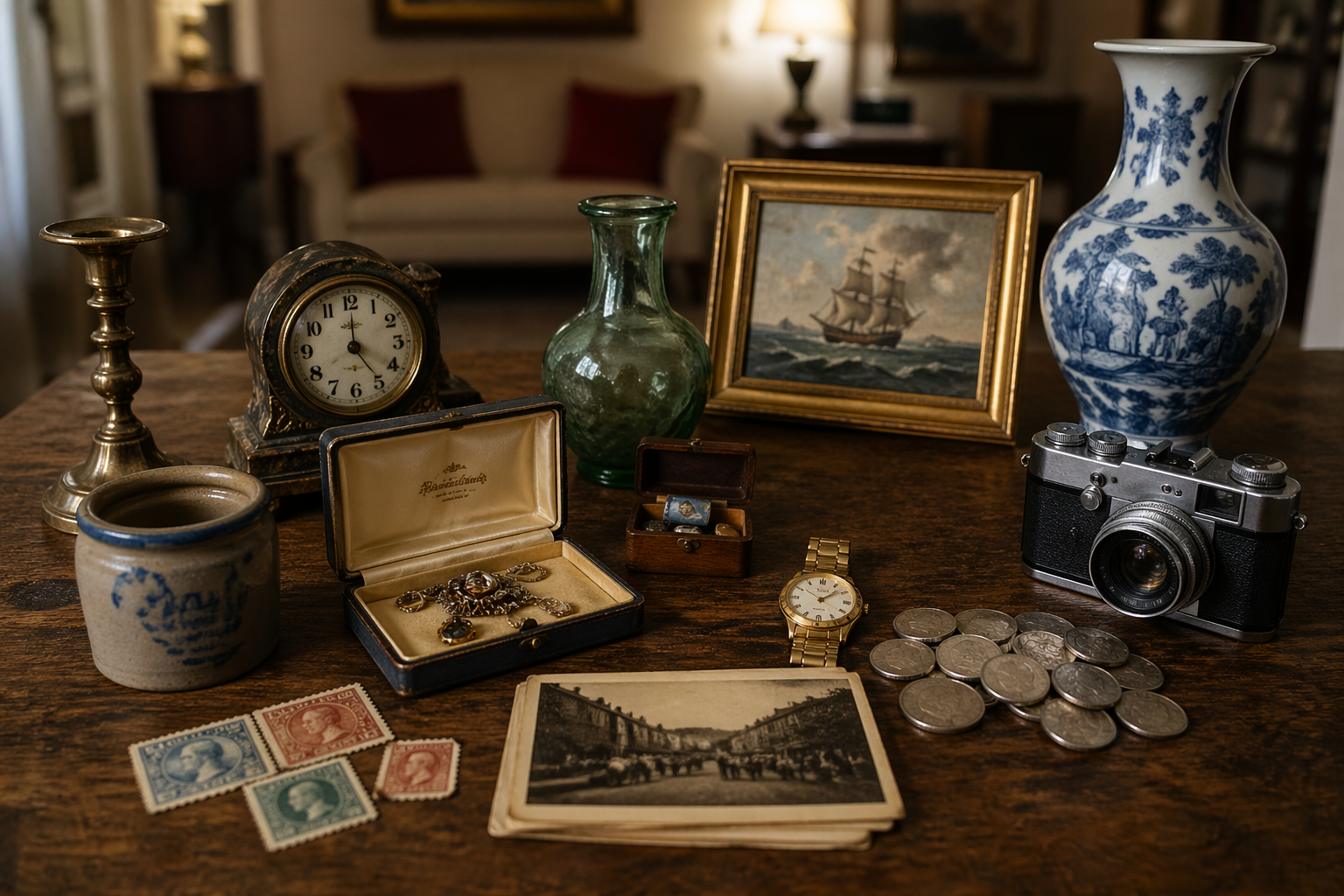
Most people assume the valuable things have already been found. The antiques were appraised. The jewelry was sorted. The coins were checked.
But in nearly every Maryland home we visit — whether it's an estate cleanout, a downsizing, or someone finally getting around to going through their parents' belongings — we find something worth real money that nobody knew about.
Sometimes it's in a coffee can in the basement. Sometimes it's in the bottom of a jewelry box under a pile of broken chains. Sometimes it's sitting in a box labeled "misc." in the back of a closet, untouched for 30 years.
The items below are the ones that surprise people most. None of them require a collector's eye to find. You just need to know what to look for.
1. Pre-1965 U.S. Coins
Let's start with the one that catches more families off guard than any other.
Before 1965, the U.S. Mint made dimes, quarters, half dollars, and silver dollars from 90% pure silver. In 1965, Congress passed the Coinage Act and switched to cheaper copper-nickel clad coins because rising silver prices had made the old coins worth more than their face value. The silver coins that survived are still out there — in jars, in sock drawers, in old purses, in change bowls that haven't been touched in decades.
Here's the quick test: look at the edge of any dime, quarter, or half dollar. Silver coins show a solid gray edge. Post-1964 coins show a visible copper stripe through the middle. Any coin dated 1964 or earlier with a solid gray edge is 90% silver.
With silver near multi-year highs in 2026, a single pre-1965 quarter contains roughly $5–6 in silver content alone — about 20 times its face value. A coffee can full of old change could easily contain $300–$500 worth of silver. And that's before factoring in any numismatic premium for key dates or high-grade examples.
What to look for: Any U.S. dime, quarter, half dollar, or dollar coin dated 1964 or earlier. Also check Kennedy halves dated 1965–1970, which are 40% silver. And don't overlook Jefferson nickels from 1942–1945 — wartime production used 35% silver, identifiable by a large mint mark above Monticello on the reverse.
2. Gold Jewelry Marked 10K, 14K, or 18K
Most people know that gold is valuable. What surprises them is just how much value can be sitting in a jewelry box they've stopped paying attention to.
The key is the stamp. Any gold jewelry marked 10K, 14K, 18K, or 24K contains real gold — not gold plating, not gold-filled, but actual gold alloy. With gold prices trading at historic highs in 2026, even a small amount of genuine gold jewelry adds up quickly. A single 14K gold chain of modest weight can be worth $200–$400 in gold content alone. A handful of broken gold pieces — a clasp here, a bent ring there, a lone earring without its pair — can collectively represent significant melt value.
The common mistake is assuming that broken, worn, or outdated jewelry has no value. It does, because gold buyers purchase for metal content, not style. The twisted necklace that's been knotted in the bottom of a jewelry box for fifteen years is worth the same as a pristine one of the same weight and karat.
What to look for: Check the inside of rings, the clasp on necklaces and bracelets, and the back of earring posts for stamped karat markings. A loupe or magnifying glass helps read worn stamps. If a piece looks like gold but you can't find a stamp, a professional can test it in seconds — don't assume unmarked means worthless.
3. Sterling Silverware and Serving Pieces
The formal silverware set that nobody uses anymore, sitting in the dining room sideboard — this is one of the most consistently undervalued items in older Maryland homes.
The most reliable way to verify your flatware is to check for a "Sterling" or "925" stamp on the back. If it's missing, a strong magnet can help rule out silver-plated items, as genuine silver is not magnetic. PGS Gold And Coin Silver-plated items (marked "EP," "EPNS," "EPBM," or "Silver Plate") have little melt value. Genuine sterling is a different story.
A typical 32-piece sterling silver flatware set can easily bring $800 to $1,500. Wealthysinglemommy.com Sets from recognized makers like Tiffany & Co., Gorham, Reed & Barton, Wallace, or Towle can command significantly more — both for their silver content and their collector appeal. As of early 2025, silver's price per ounce has risen into the $30/oz range from around $25/oz in 2022, meaning the intrinsic value of sterling items is higher now than it has been in recent years. Sebastian Charles
Don't overlook individual serving pieces either: sterling candlesticks, tea sets, bread baskets, and decorative trays all carry real value. Even a single well-made sterling spoon can be worth $20–$30 in silver content alone.
What to look for: Turn any piece of silverware over and look for "Sterling" or "925" stamped on the back. Check tea sets, serving bowls, candlesticks, and decorative trays as well as flatware. Bring a magnet — genuine silver won't stick.
4. Vintage Pocket Watches
That heavy watch tucked in a small box in the back of a dresser drawer — the one with the hinged case and the chain — deserves a much closer look than it typically gets.
In today's market, vintage pocket watch values can range from under $100 to well over $10,000. More typical prices for mid-range examples — like American-made railroad watches from Waltham or Hamilton in working condition — might fall between $200 and $800. Swiss pocket watches from respected maisons can go higher, especially if crafted in precious metals or with additional complications. Sebastian Charles
Several factors determine value: the maker (Elgin, Waltham, Hamilton, and Illinois are respected American brands; Patek Philippe and Vacheron Constantin represent the top of the Swiss market), the case material (solid gold cases carry both melt value and collector premium), the movement condition, and whether the watch still runs. A solid gold pocket watch in working condition from a respected maker can easily be worth $1,000–$5,000 or more.
Even watches that don't run have value. A non-functioning watch in a gold case is still worth the gold in the case, and movements from respected makers have parts value to watchmakers and collectors.
What to look for: Open the back case and look for maker's name and serial number on the movement. Check the case for gold karat stamps (10K, 14K, 18K). Count the jewels in the movement — generally, more jewels indicates higher quality. Note whether the watch winds from the crown (stem-wind) or requires a separate key (key-wind) — key-wind watches tend to be older and often more valuable.
5. Old Baseball Cards and Sports Memorabilia
The shoebox of baseball cards from childhood. The cards that came with bubblegum, filed in a binder, stored in a bedroom closet since the 1970s. Most people assume these are worth nothing — and for certain eras, that's largely true. But for the right cards in the right condition, the numbers can be staggering.
Baseball card values can vary wildly — from a few dollars to hundreds of thousands — depending on factors like age, scarcity, condition, and player popularity. Cards from the late 1980s and early 1990s saw massive overproduction, flooding the market. As a result, even rookie cards of notable players from this era are often worth less than $5. All Vintage Cards
But cards from before 1980 are a completely different category. The 1952 Topps Mickey Mantle, considered the most iconic and rare baseball card of the post-war era, sold for a staggering $12.6 million at an auction in 2022. Wealth Gang You're almost certainly not sitting on one of those — but pre-war tobacco cards, 1950s and 1960s Hall of Famer rookies, and Topps sets from the early years of the hobby can be genuinely valuable, especially in better condition.
The rule: pull out any cards of Hall of Famers or legendary players from before 1980 and treat them with care. Condition is everything — cards with sharp corners, no creases, and original coloring are worth dramatically more than worn examples of the same card.
What to look for: Pre-1980 cards of recognized Hall of Famers and legendary players: Mickey Mantle, Willie Mays, Babe Ruth, Hank Aaron, Ted Williams, Roberto Clemente, Jackie Robinson, and their contemporaries. Early Topps sets from the 1950s and 1960s. Tobacco cards from the early 1900s (T206 series). Condition is paramount — handle with care and keep in protective sleeves.
6. Broken or "Costume" Jewelry That's Actually Real
Costume jewelry gets a bad reputation, and most of it deserves it. But the category gets applied too broadly, and a lot of genuinely valuable jewelry ends up dismissed, donated, or thrown away because someone assumed it wasn't real.
Here's the thing: gold and silver jewelry was commonly given as gifts throughout the 20th century, and plenty of it looks unremarkable. Engagement rings from the 1940s and 1950s. Anniversary gifts from the 1960s. Family pieces that were "just jewelry" for decades. The fact that a piece looks old, worn, or unfashionable tells you nothing about whether it's real.
The stamp is what matters. Check the inside of rings, the clasps of necklaces, the backs of earring posts. A "14K," "18K," "10K," "925," or "Sterling" stamp means real precious metal — regardless of how the piece looks on the outside. And for pieces with stones, don't assume a stone isn't real just because the setting is modest. Older diamond rings in particular are often underestimated because the stones are old-cut rather than modern brilliant cuts, which look different but are absolutely genuine diamonds.
Broken pieces carry full melt value. A snapped 14K chain is worth exactly as much as an intact one of the same weight and karat.
What to look for: Check every piece of jewelry in the home — rings, necklaces, bracelets, brooches, earrings — for karat stamps before discarding anything. Use a magnifying glass for worn stamps. Set aside anything with stones for professional evaluation. Don't throw away broken pieces.
7. Old Pocket Knives, Military Insignia, and Wartime Collectibles
This is a category that catches people almost entirely off guard, because the items in question don't look like they belong in a display case or an auction house. They look like the miscellaneous wartime souvenirs that every family with a veteran member seems to have tucked away somewhere.
When it comes to military memorabilia, medals and decorations hold a special place. Among the most sought-after pieces are service medals and combat awards. Collectors and historians alike seek these items for their historical significance and aesthetic appeal. Prestigeestateservices
The value of military collectibles is driven heavily by documentation and provenance. The documentation is just as important as the medal itself. The original award certificate, the presentation box, and photos of the recipient add immense value. They prove the medal is authentic and connect it to a real person and their history. Identify Medals
Beyond medals, look for: named dog tags, discharge papers (DD-214s), unit insignia and patches, WWII-era Japanese or German captured souvenirs, period uniforms with insignia intact, and wartime photographs with identifying information. The more complete the story — the more documentation, the more provenance — the greater the value.
One important note: certain high-valor decorations including the Medal of Honor and Purple Heart are subject to legal restrictions on commercial sale under U.S. law. If you have these items, consult with a professional before attempting to sell them.
What to look for: Medals with original ribbons and presentation cases. Named or documented pieces with paperwork. WWII-era souvenirs in original condition. Unit insignia, patches, and photographs. The combination of medal plus documentation is worth dramatically more than the medal alone.
8. Pre-1980 Topps and Bowman Baseball Cards — and Pre-War Tobacco Cards
We touched on this above, but it deserves its own callout for the specific eras that matter most.
The "junk wax era" — roughly 1987 to 1993 — produced cards in such extraordinary quantities that most of them have minimal value today regardless of the player. But cards from before that era are a completely different market.
Cards depicting legendary players such as Hank Aaron, Mickey Mantle, or Jackie Robinson are inherently more valuable than most others. Start your assessment by pulling out cards of household names and Hall of Famers, as valuing these cards first will give you insights into the overall value of your stash. Cardhound Vintage
Pre-war tobacco cards from the T206 set (1909–1911) — the ones that came in cigarette packs a century ago — are among the most valuable trading cards ever made. Most common players from that set in average condition are worth $20–$100. Stars from the same set in similar condition can be worth thousands. And the Honus Wagner from that set is the most valuable sports card ever made, with examples regularly trading for millions.
What to look for: Any cards predating 1980. T206 tobacco cards in any condition. 1950s and 1960s Topps sets. Rookie cards of Hall of Famers. For any card that looks potentially valuable, keep it in a protective sleeve and have it professionally evaluated before touching it further.
9. Morgan and Peace Silver Dollars
These deserve their own entry separate from the general pre-1965 silver discussion, because they're common enough to turn up in almost any older home — and consistently underestimated by everyone who hasn't spent time in the coin market.
Morgan dollars were struck from 1878 to 1921. Peace dollars ran from 1921 to 1935. Both series are 90% silver and contain 0.7734 troy ounces of silver per coin. At current silver prices, the floor value of any Morgan or Peace dollar — regardless of date or condition — is approximately $25–$30 in silver content alone. Most circulated common-date examples are worth $35–$60. Better dates, higher grades, and mint-marked varieties from lower-mintage facilities can be worth hundreds to thousands.
The challenge is that most people who find a box of silver dollars in an estate have no way of knowing which ones are the common dates and which ones aren't. A bag of 20 Morgan dollars might be worth $600 in silver — or it might contain a single coin worth $2,000 if one of those coins happens to be a low-mintage Carson City issue in better-than-average condition.
What to look for: Large silver coins about the size of a modern half dollar with "E Pluribus Unum" and "In God We Trust." Morgan dollars feature Lady Liberty on the obverse and an eagle on the reverse. Peace dollars show Liberty facing right with a radiant crown. Don't clean them, don't store them in plastic bags that can scratch the surfaces, and don't sell any as a bulk lot before having them individually examined.
10. Sterling Silver Tea Sets, Trays, and Decorative Objects
Beyond silverware, there's a whole category of sterling silver decorative items that frequently gets overlooked in older homes: tea sets, coffee services, trays, candlesticks, picture frames, decorative bowls, sugar and creamer sets, and serving pieces.
These items often live in dining room sideboards, china cabinets, or storage boxes — brought out for special occasions and then put back. Many haven't been touched in decades. And because they tend to tarnish, they're often assumed to be worthless silver plate.
The test is the same as with flatware: look for "Sterling" or "925" stamped somewhere on the piece — usually on the bottom of a tray or serving piece, inside a lid, or on the base of a candlestick. A sterling silver tea set from a quality maker can be worth $500–$3,000 depending on weight, maker, and condition. Antique Tiffany silverware patterns are prized possessions. While some sets may be closer to $1,000 in value, others can value at tens of thousands of dollars or more. Samuelson's Diamonds
Picture frames, dresser sets, and small decorative objects in sterling silver are also commonly overlooked. A sterling silver picture frame from the early 1900s in good condition can be worth $100–$300. A matching dresser set — comb, brush, mirror, and tray — can be worth $400–$800 if the pieces are all present.
What to look for: Turn every decorative silver-colored object over and look for hallmarks. Check lids and bases. A tarnished black piece that looks like junk might be a 200-gram sterling tea pot worth several hundred dollars in silver alone.
The Common Thread
Notice what every item on this list has in common: none of them announce their value. A coffee can of old change looks like a coffee can of old change. A box of jewelry looks like a box of old jewelry. A set of silverware in a sideboard looks like a set of silverware in a sideboard.
Value hides in plain sight, in items that have been part of the background for so long that nobody thinks to look at them closely. That's why professional eyes matter — and why so many families who thought they had nothing to sell discover otherwise once someone who knows what to look for actually takes a look.
Think You Might Have Something?
You don't need to know what you have before calling us. That's exactly what we're here to figure out together.
Sanford & Son visits homes anywhere in Maryland, evaluates coins, jewelry, collectibles, and estate items on the spot, and makes fair cash offers based on current market values. Licensed, bonded, insured, and NGC member. No pressure. No obligation. No surprises.
📞 Call or text: (410) 746-5090 Open 7 days a week, 7am–7pm
🌐 Contact us online: sanfordandsoncoins.com/contact-us.html
One visit. Fair offer. Cash in hand.
Frequently Asked Questions
How do I know if my silverware is sterling or silver-plated?
Turn any piece over and look on the back of the handle for a stamp. Genuine sterling silver is marked "Sterling," "Sterling Silver," "925," or "SS." Silver-plated pieces are typically marked "EP," "EPNS," "EPBM," "Silver Plate," or just "SP." If there's no marking at all, a simple magnet test can help rule out plating — genuine silver won't attract a magnet, though this test isn't definitive for all non-silver metals. When in doubt, a professional can test the piece in seconds using electronic tools.
I have a bunch of old coins but I don't know which ones matter. What should I do?
Don't sort, clean, or spend any of them before having them looked at. The simplest first step: pull out any dimes, quarters, and half dollars dated 1964 or earlier — those are 90% silver and worth well above face value. Set aside any silver dollars, any coin in a labeled holder or folder, and anything that looks unusual. Then call us. We'll go through everything on the spot and tell you exactly what you have.
My jewelry doesn't have any stamps — does that mean it's not real gold or silver?
Not necessarily. Stamps can wear off over time, particularly on older pieces. Some antique jewelry predates the requirement for karat stamping. A piece without a visible stamp should be tested by a professional before you assume it has no value. We use electronic testing tools that can verify metal content accurately and without damaging the piece.
Are cards from the 1980s worth anything?
Most cards from the late 1980s through early 1990s are worth very little because they were mass-produced in enormous quantities. The exception is cards in verified gem mint condition (PSA 10 or equivalent), certain short-printed inserts, and a small number of star player rookies. Cards from before 1980, and especially before 1970, are in a completely different category — pull those out and treat them carefully.
What makes a pocket watch valuable versus ordinary?
The main factors are maker, case material, condition, and whether the watch runs. Watches from respected American makers like Elgin, Waltham, and Hamilton in working condition with solid gold cases are worth $500–$2,000+. Swiss watches from Patek Philippe, Vacheron Constantin, or similar maisons can be worth far more. If your pocket watch has a hinged case, open the back and look for the maker's name stamped on the movement — that's the most important identifier.
I found some old military items in my father's things. Are they worth selling?
It depends on what you have. Named medals with original documentation and provenance are worth significantly more than unnamed ones. WWII-era insignia, uniforms with patches intact, and captured souvenirs from the European and Pacific theaters are actively collected. Be aware that certain high-valor decorations — including the Medal of Honor and Purple Heart — have legal restrictions on commercial sale. Bring everything together and have it evaluated before making any decisions about selling.
How do I know if my gold jewelry is real if I can't find a stamp?
The most reliable method is professional testing. We use electronic gold testers that measure karat content through the metal surface without scratching or damaging the piece. A quick visual check using a loupe under good light can also sometimes reveal worn stamps that aren't visible to the naked eye. Don't discard any piece that looks like gold without testing it first.
Can Sanford & Son evaluate all of these categories in a single visit?
Yes. A single Sanford & Son home visit can cover coins, jewelry, silverware, pocket watches, sports memorabilia, military collectibles, and general estate contents all in one appointment. You don't need to sort everything in advance or know what category things belong to — we'll work through everything together and tell you what we're seeing in plain language.
